Towing a car is one of those situations that drivers rarely think about – until a sudden breakdown forces them to make a quick decision. Can I take a rope from a friend and drive to the workshop? How far can I go? What are the requirements? Polish regulations in this area are specific, and violating them can result in a fine or, worse, serious damage to the vehicle. Below you will find a complete overview of towing rules in accordance with Article 31 of the Road Traffic Law.
Legal conditions for towing – Article 31 sec. 1
According to Article 31 of the Road Traffic Law (Journal of Laws 2024, item 1251), towing a motor vehicle is allowed, but only if all of the following conditions are met simultaneously.
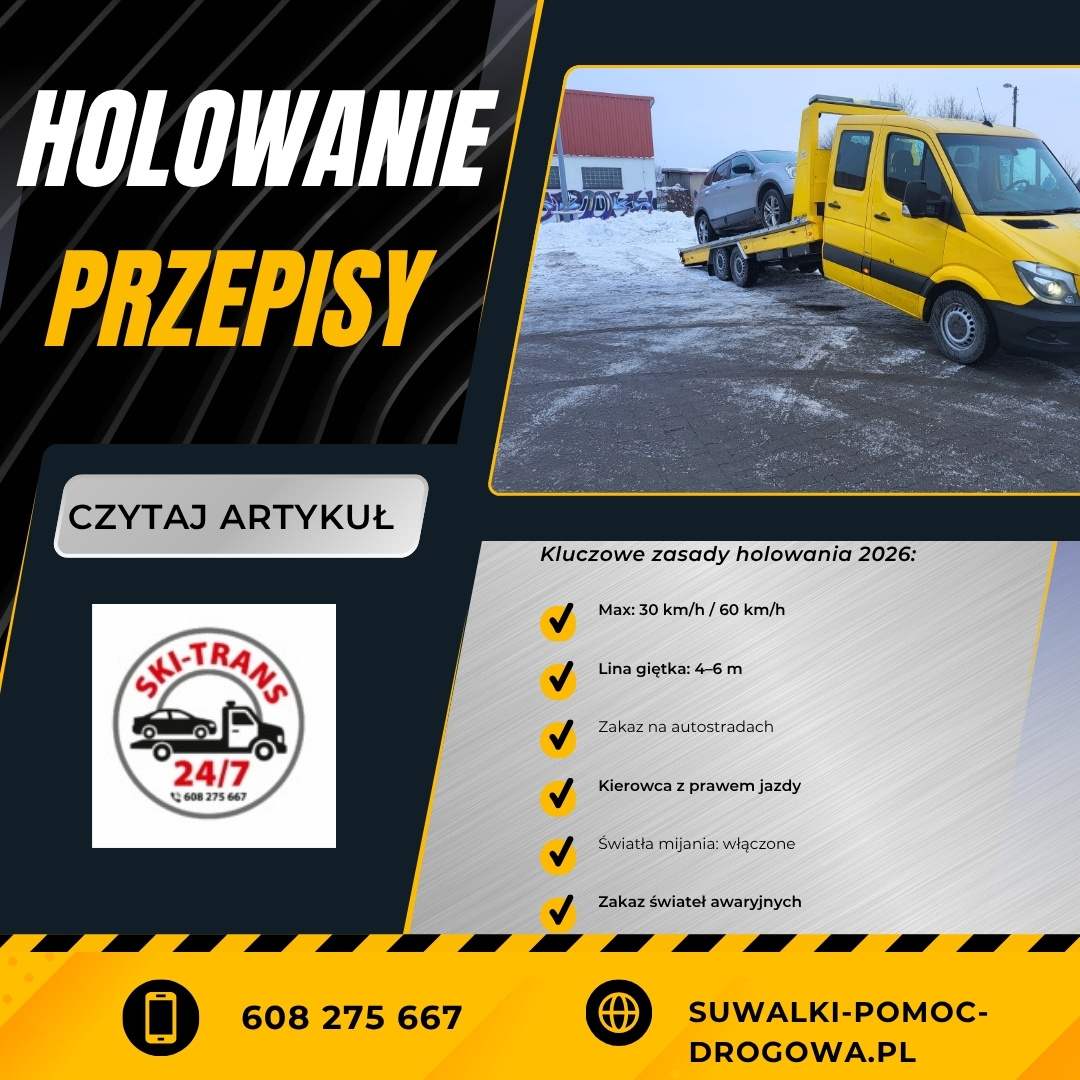
1. The speed of the towing vehicle does not exceed 30 km/h in built-up areas and 60 km/h outside of them. 2. The towing vehicle has its low beam lights on – even in sufficient visibility. 3. The towed vehicle has a driver with a valid license to operate that vehicle (unless the method of towing excludes the need for driving it). 4. The connection between the vehicles prevents detachment while driving. 5. The towed vehicle is properly marked.
It is worth emphasizing that towing a passenger car with another passenger car is legal, provided that all requirements are met. The law allows towing one vehicle – towing more than one vehicle at the same time is prohibited (exception: articulated vehicle).
The driver of the towed vehicle must have a valid driver’s license of the appropriate category and must not be under the influence of alcohol or drugs – the same requirements apply as for normal driving.
Flexible connection (rope) vs rigid tow – differences and requirements
The type of connection between vehicles has significant legal and practical implications. A tow rope and a rigid tow are two different solutions with different technical requirements arising from regulations.
| Parameter | Flexible connection (rope) | Rigid tow (bar) |
|---|---|---|
| Length of connection | 4–6 meters | max 3 meters |
| Marking | White-red stripes OR flag (yellow or red) | White-red stripes OR flag (yellow or red) |
| Vehicle with faulty braking system | Prohibited | Allowed (if it excludes the need to use brakes) |
| Vehicle with faulty steering system | Prohibited | Allowed (if it excludes the need to steer) |
| Motorcycle | Allowed – the only legal method | Prohibited for motorcycle |
| Brakes dependent on the engine (engine off) | Prohibited | Allowed (if it excludes the need to use brakes) |
Regulations (Art. 31 sec. 1 point 4) require that the flexible connection (rope, chain) be between 4 and 6 meters long. A rope that is too short increases the risk of collision between vehicles. 3 meters is the limit for a rigid connection (tow bar), not for a rope.
Regulations do not explicitly prohibit towing a car with an automatic transmission using a rope or rigid tow. However, manufacturers and workshops warn: the automatic transmission is not lubricated when the engine is off – towing for more than a few kilometers can cause permanent damage. This is a technical risk, not a legal one. Safe solution: flatbed truck with all wheels loaded.
Speed and traffic rules when towing
According to Art. 31 sec. 1 point 1, maximum speeds when towing a motor vehicle are lower than standard limits:
🏙️ Built-up area
Maximum speed: 30 km/h
(standard limit: 50 km/h)
🛣️ Outside built-up area
Maximum speed: 60 km/h
(niezależnie od dopuszczalnego limitu na danej drodze)
🚘 Droga ekspresowa
Holowanie dozwolone do najbliższego zjazdu lub MOP, maks. 60 km/h
W pojezie holowanym musi znajdować się kierujący z ważnym prawem jazdy – chyba że poj. jest holowany w sposób wykluczający potrzebę kierowania nim. Gdy holujemy w sposób wykluczający potrzebę kierowania (np. na belce z blokadą skrętu), masa holowanego nie może przekraczać masy holującego.
Podczas holowania oba pojazdy muszą poruszać się prawym pasem ruchu na drogach wielopasmowych. Holowanie jest dopuszczalne wyłącznie na odcinku niezbędnym do dotarcia do najbliższego warsztatu lub bezpiecznego miejsca.
Oświetlenie, sygnalizacja i oznakowanie
Przepisy precyzyjnie określają wymagania dotyczące oświetlenia i oznakowania dla obu pojazdów. Jednym z częstszych błędów kierowców jest używanie świateł awaryjnych zamiast kierunkowskazów.
- 1
Pojazd holujący – światła mijania Musi mieć włączone światła mijania również w okresie dostatecznej widoczności. To wymóg ustawowy, a nie tylko zalecenie.
- 2
Pojazd holowany – trójkąt odblaskowy LUB żółte sygnały błyskowe Pojazd holowany (z wyjątkiem motocykla) musi być oznaczony ostrzegawczym trójkątem odblaskowym z tyłu po lewej stronie pojazdu. W okresie niedostatecznej widoczności dodatkowo muszą być włączone światła pozycyjne. Alternatywnie pojazd może wysyłać żółte sygnały błyskowe widoczne dla innych uczestników ruchu.
- 3
Zakaz używania świateł awaryjnych Podczas holowania kierowcy muszą sygnalizować skręty i manewry kierunkowskazami. Włączenie świateł awaryjnych blokuje możliwość sygnalizowania kierunkowskazem.
- 4
Oznakowanie połączenia Lina lub sztywny hol muszą być oznakowane na przemian pasami białymi i czerwonymi albo zaopatrzone w chorągiewkę barwy żółtej lub czerwonej.
To jeden z najczęstszych błędów kierowców. Włączenie “czterechu kierunkowskazów” uniemożliwia sygnalizowanie skrętów i manewrów. Sygnalizacja musi odbywać się normalnie – kierunkowskazami. W razie kolizji wynikłej z braku prawidłowej sygnalizacji odpowiedzialność prawna i ubezpieczeniowa może spaść na kierowcę.
Bezwzględne zakazy – kiedy wymagana jest laweta
Art. 31 ust. 2 zawiera katalog sytuacji, w których holowanie jest bezwzględnie zakazane. W tych przypadkach jedyną legalną opcją jest wezwanie lawety lub specjalistycznej pomocy drogowej.
| Sytuacja | Is towing allowed? | Legal basis |
|---|---|---|
| Motorway | Prohibited (exception: vehicles intended for towing to the nearest exit/MOP) | Art. 31 sec. 2 point 5 |
| Expressway | Allowed to the nearest exit or MOP, max 60 km/h | Art. 31 sec. 1 point 1 |
| Vehicle with a faulty steering system | Prohibited by rope (unless the towing method excludes the need for steering) | Art. 31 sec. 2 point 1 |
| Vehicle with a faulty braking system | Prohibited by rope (unless the towing method excludes the need to use brakes) | Art. 31 sec. 2 point 1 |
| Vehicle where brakes depend on the engine, and the engine is off | Prohibited by rope | Art. 31 sec. 2 point 2 |
| More than one vehicle towed simultaneously | Prohibited (exception: articulated vehicle) | Art. 31 sec. 2 point 3 |
| Motorcycle using a rigid tow | Prohibited | Art. 31 sec. 1 point 4 |
When the breakdown occurs on the motorway, when the vehicle has faulty brakes or a steering system without the possibility of locking, when you plan to cover more than a few kilometers, or when you have a car with an automatic transmission and the risk of damaging the transmission is high – call 608 275 667.
Consequences of violating regulations
Violating towing regulations may result in a fine. Penalties can accumulate with multiple violations at once. Besides the fine, the most serious consequence may be the lack of insurance coverage – if a collision occurs during illegal towing, the insurer may refuse to pay compensation.
Towing a vehicle with a faulty braking or steering system using a rope instead of a tow truck may result not only in a fine but also in the police retaining the registration certificate of the towed vehicle.
A flexible connection (towing rope, chain) must be between 4 to 6 meters (Art. 31 sec. 1 point 4). A rope that is too short increases the risk of being hit by the towed vehicle. Note: 3 meters is the limit for a rigid connection (tow bar), not for a rope. The rope must also be marked with white and red stripes or a flag.
According to Art. 31 sec. 1 point 1: 30 km/h in built-up areas i 60 km/h outside built-up areas. The 60 km/h limit applies regardless of the permissible speed on a given road – even on an expressway where the normal limit is 120 km/h.
Yes, a motorcycle can be towed, but only using a flexible connection (rope) and in a way that allows for easy detachment (Art. 31 sec. 1 point 4). Towing a motorcycle with a rigid tow (bar) is prohibited. Connection length: 4–6 m.
Yes. The prohibition on towing with a regular vehicle applies only to motorways (Art. 31 sec. 2 point 5). Towing is allowed on an expressway – but only to the nearest exit or service area, at a maximum speed of 60 km/h. On a motorway, towing can only be performed by a vehicle specifically designed for this purpose (e.g., a tow truck).
It depends on the situation. If the breakdown is due to a collision caused by another driver – the cost of the tow truck is covered by the at-fault driver’s liability insurance as part of the property damage. If it is a technical breakdown – it may be covered by assistance insurance (if you have it) or comprehensive insurance with assistance option. It is worth reporting the cost of the tow truck to your insurer even if you are not sure – a denial can always be appealed.
Breakdown? Call SKI TRANS – Road Assistance Suwałki
We operate 24 hours a day, 7 days a week. Tow trucks, platforms, tractors for TIRs. We serve the entire Suwałki region, Via Baltica, and routes to the Baltic countries.