
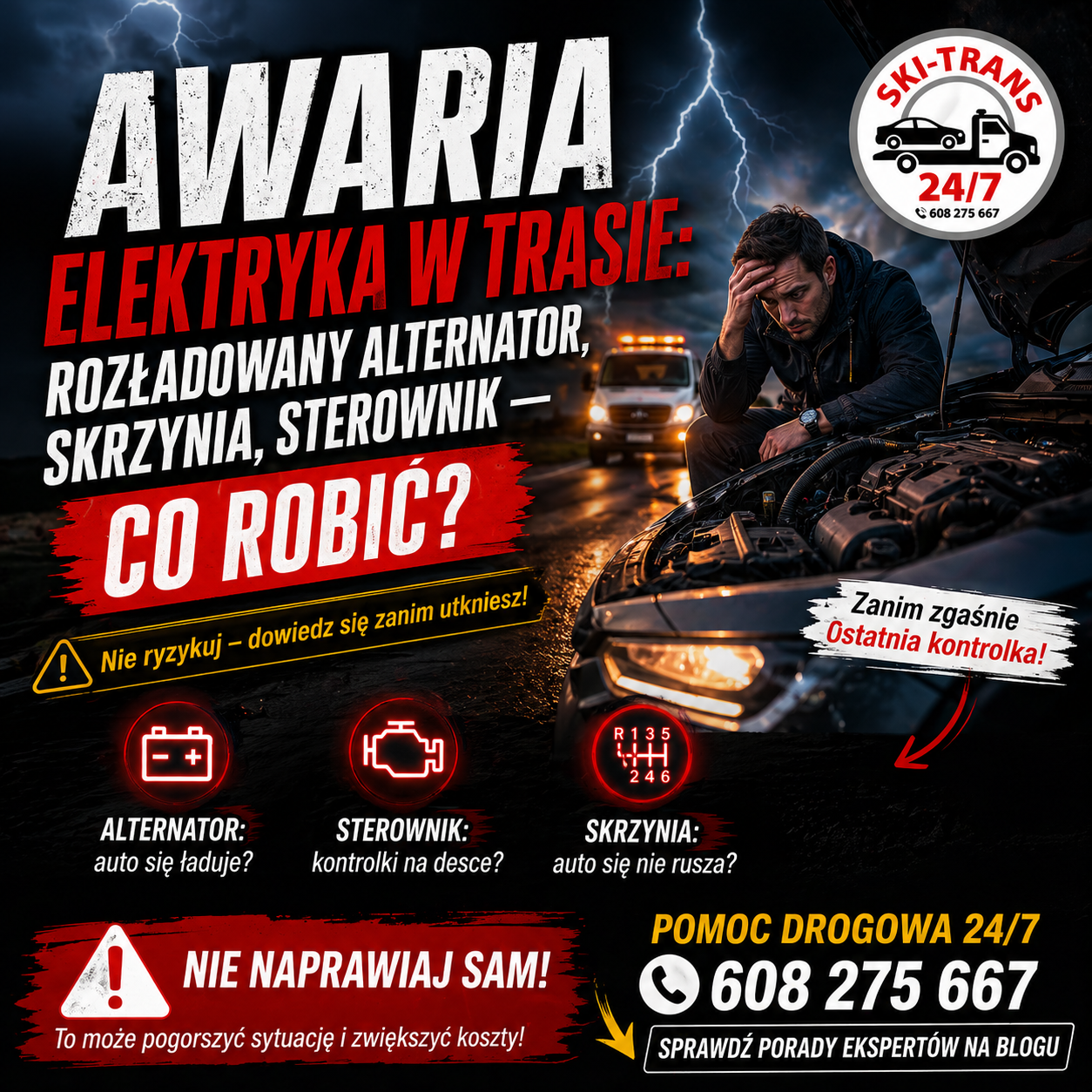
Electrical failure of the car on the road — how to recognize what is malfunctioning?
An electrical failure of the car on the road is one of the more challenging situations for a driver — there are no visible damages, and the car suddenly stalls, loses power, or won’t start. The alternator, engine controller, and gearbox have completely different symptoms. Knowing what to look for, you can provide key information to the mechanic and make the right decision: try to continue driving or call for a tow truck immediately.
Electrical failures are a category where drivers most often make mistakes — either they try to continue driving when they shouldn’t, or they call for help when they could safely reach a service station. This guide will help you assess the situation, avoid panic, and make the right decision.
Alternator failure — symptoms and what to do
The alternator charges the battery while driving. When it stops working, the car runs on stored energy — but only for a short time. Here’s how to recognize an alternator failure:
⚡ Battery light on the dashboard
The first and most important piece of information. The red battery light (a rectangle with + and − signs) indicates that the alternator is not charging. Do not confuse it with the oil light.
💡 Dimming lights and electrical issues
The radio goes quiet, the lights dim, the air conditioning shuts off — the car gradually loses power. These are classic symptoms of a discharging battery without recharging from the alternator.
🔊 Squealing from the engine area
A squeaking or screeching sound from the left side of the engine may indicate a worn alternator belt or bearing. It usually appears before a complete failure.
🔋 Car won’t start after a stop
If the engine won’t start after a short break despite a functioning battery — the battery has discharged because the alternator wasn’t charging while driving.
Turn off all electrical devices (air conditioning, radio, windshield heater, rear wiper). Drive directly to the workshop — you have 20 to 50 minutes of driving before the battery completely discharges. Do not stop the engine unnecessarily. If the battery light appears and disappears — that’s an early warning sign. Don’t wait for the problem to 'resolve itself.’
Engine control unit failure — symptoms and what to do
The engine control unit (ECU/ECM) is the computer that manages the engine’s operation. Its failure can be serious or minor — it depends on what errors appear in the diagnostics. Without diagnostic equipment, it’s hard to assess the severity of the situation.
| Symptom | Possible cause | Can you drive? |
|---|---|---|
| Check engine light | Controller error — various codes | Often yes — go for diagnostics |
| Car drives in 'limp mode’ — limited RPM | Controller’s limp mode | Only to the service — no acceleration |
| Engine stalls while driving | Controller or sensor failure | NO — call for a tow truck |
| Engine won’t start despite a functioning battery | Controller not communicating with the immobilizer | NO — service or tow truck |
| Jerkiness, uneven engine operation | Incorrect sensor readings | Cautiously — drive to the service |
Never try to 'reset’ the controller by disconnecting the battery if the car is on S61 or Via Baltica. Resetting may erase error codes that the mechanic needs for diagnosis. Wait for the tow truck and hand over the car with the error codes intact.
Transmission failure — symptoms and what to do
Transmission failure — both manual and automatic — is one of the more expensive faults. Improper towing after a failure can cost tens of thousands of zlotys. Recognize the symptoms before it’s too late:
| Symptom | Manual transmission | Automatic transmission |
|---|---|---|
| Car won’t move from a standstill | Damaged clutch or synchronizers | Oil pump or transmission controller failure |
| Noise when shifting gears | Worn synchronizers | Slipping multi-plate clutch |
| Gear slipping 'by itself’ | Worn forks or bearings | Incorrect hydraulics |
| Car shaking during acceleration | Burnt clutch disc | Slipping in the transmission |
| Oil under the car (rusty or black) | Housing gasket | Oil pan or transmission cooler gasket |
Towing a car with an automatic transmission with the drive wheels on the ground damages the transmission. Automatic transmission lubrication only works when the engine is running — during towing on a wheel, the transmission rotates 'dry’. A platform or 4-wheel loading is required. Inform the dispatcher about this before the tow truck arrives.
What NOT to do in case of an electrical failure on the road
Mistakes made by drivers during electrical failures often increase damage and repair costs. Here’s a list of the most common — and costly — mistakes:
Do not try to drive further if the engine is clearly losing power
An engine running in limp mode or with a clear loss of power can suffer more serious damage. Every additional kilometer = risk of greater damage and a higher bill at the workshop.
Do not disconnect the battery to 'reset’ the car
Resetting erases error codes from the controller. The mechanic loses the most important diagnostic information. Leave the codes and go on a tow truck to the service with the full history of errors.
Do not try to tow a car with an automatic transmission using a rope or basket
An automatic transmission requires lubrication while in motion. Towing on a wheel damages the transmission and can cost 5,000–20,000 PLN to repair. Always mention the type of transmission when ordering a tow truck.
Do not ignore a squeaking alternator belt
A squeaking belt is an early warning. Replacing the belt costs 100–300 PLN. Alternator failure due to a broken belt — many times more. React at the first signs.
Do not turn off the engine if you have an alternator failure and can still drive
In case of alternator failure, energy from the battery lasts for 20–50 minutes of driving. Restarting after turning off may be impossible. Drive straight to the service without stopping.
When to immediately call for a tow truck?
Not every electrical failure requires a tow truck — but in these situations, calling one is the only reasonable decision:
🚨 The engine stalls while driving
Engine stalling while driving, especially at speeds above 60 km/h, indicates a serious electrical or fuel system fault. Do not attempt to restart on a busy road.
🔥 Smoke from the engine or the smell of burning
Smoke or the smell of electrical burning is an immediate signal to stop and call for help. The risk of an electrical fire is real.
⚡ Multiple warning lights at once
The simultaneous illumination of multiple warning lights (battery + engine + ABS + ESP) is a sign of a serious electrical failure. Do not attempt to diagnose — call for a tow truck.
🚗 Car with an automatic transmission won’t move
A car with an 'auto’ transmission that is stationary and unresponsive to mode changes (P/R/N/D) requires a flatbed. No towing on a wheel — call for a flatbed immediately.
Provide: the make and model of the car, year of manufacture, type of transmission (manual/automatic), which warning lights are on, whether the car stalls or won’t start, and the exact location (road number + direction + km or town). This helps send the appropriate equipment — flatbed vs. tow truck matters.
FAQ — frequently asked questions about electrical failures
The 'check engine’ light does not always indicate immediate danger — often it’s a sensor or exhaust system error. You can cautiously drive to a diagnostic service, but do not ignore the light. If the car simultaneously loses power, jerks, or the engine stalls — stop and call for help.
The alternator can be refurbished (rewinding, brush replacement, diodes) — it usually costs 150–400 PLN plus labor. A new alternator costs 400–1,500 PLN. The decision depends on the age and condition of the car — refurbishment is cheaper but less reliable for older vehicles. A mechanic should assess the cost-effectiveness after disassembly.
With a functioning and charged battery — usually 20–50 minutes of driving. The time depends on the battery capacity and the number of active electrical consumers. Turn off everything you can (air conditioning, radio, fan, heating) and drive directly to the workshop without stopping the engine.
No. Many controller failures are software errors, damaged sensors, or broken connector connections — not physical damage to the computer itself. Computer diagnostics may reveal a simple error to clear or a more expensive problem with the ECU itself. The cost of a new controller is 500–3,000 PLN, refurbished — 300–1,500 PLN. Diagnostics first.
The cost of towing with a flatbed depends on the distance and time of day. In the Suwałki region, the starting rate is usually 150–200 PLN, plus 3–5 PLN per km. Night and weekend surcharges are +20–50%. SKI TRANS provides a full price list upon request — call for a quote before agreeing to tow with other companies.
Electrical failure of a car in Suwałki or on the S61? We arrive in 15 minutes.
SKI TRANS Road Assistance — flatbed towing, platform for automatic and EV cars, assistance on S61 and Via Baltica. We operate 24/7, 365 days a year. Tell us what type of transmission you have — we will come with the right equipment.