
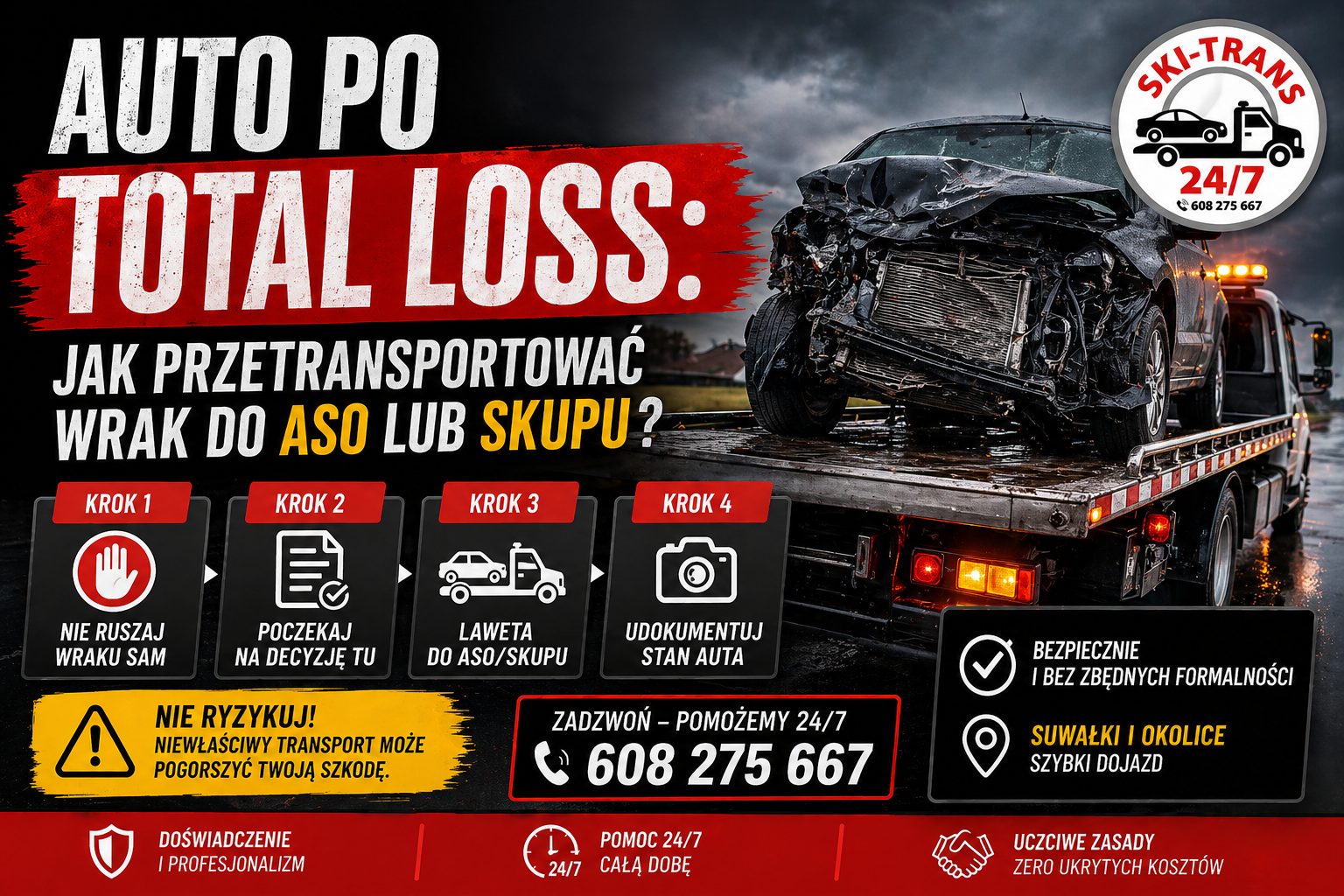
Total loss — what next for the car? A step-by-step guide
Total loss is the insurer’s decision that the cost of repairing the vehicle exceeds its market value. What then? Most guides explain the insurance procedure but overlook the key practical question: what to do with the wreck physically — how to remove it from the scene, transport it to the service center, salvage yard, or junkyard — and how to avoid further damage during transport.
The decision on total loss marks the end of one process and the beginning of another — what to do with a car that is officially a 'wreck’ in the insurer’s eyes. Many people do not know that they have a choice regarding the future of the vehicle, and that transporting the wreck has its rules, which are worth knowing before you call for a tow truck.
First steps after the total loss decision
The insurer has informed you about the total loss. What now, in what order?
Do not move the wreck without the insurer’s consent
Until the claims process is completed, the wreck is formally 'secured’ by the insurer. Unauthorized movement, sale, or dismantling of parts may result in a reduction or denial of compensation. Wait for a written decision.
Decide whether to keep the wreck or return it to the insurer
You have a choice: accept full compensation and return the wreck to the insurer, or accept a lower compensation (reduced by the value of the wreck) and keep the car. Keeping it is worthwhile if you have a mechanic friend or plan to sell it to a salvage yard. Ask for both valuations.
Document the car’s condition before transport
Take photos from all sides, interior photos, and dashboard photos. Documentation protects you if additional damage occurs during transport and when disputing the insurer’s valuation.
Plan the transport of the wreck to the destination
The wreck cannot go on its own — it requires a tow truck. The destination is usually a service center (if you are fighting for repairs), a salvage yard, or a dismantling station (junkyard). Each of these places requires different formalities when handing over the car.
Options for what to do with the wreck after total loss
After the total loss decision, you have several paths. The choice depends on whether you keep the wreck or not, and on the condition of the car.
| Option | When it’s worth it | What you need | Who organizes the transport |
|---|---|---|---|
| Return to the insurer | Full compensation, wreck heavily damaged | Written decision, registration document | Insurer (You can speed this up) |
| Transport to ASO — appeal against the decision | You dispute the valuation, want an independent opinion | Order repair or valuation from ASO | You — order a tow truck |
| Sale to a damaged vehicle buyer | You keep the wreck, want to quickly monetize it | Registration document, vehicle card | You — order a tow truck or the buyer picks it up themselves |
| Transport to a scrapyard (dismantling station) | Car is not suitable for repair or sale | Registration document, deregistration | You — order a tow truck |
| Repair — you keep the wreck | You have a mechanic friend, it’s worth repairing the car | Diagnosis, repair cost estimate | You — transport to the service |
Damaged vehicle buyers usually value the car online (photos + description) and offer pickup with their own transport — sometimes free. Compare several offers before deciding. Remember that the buyer’s valuation is lower than the 'wreck value’ calculated by the insurer — this is normal.
Transport of the wreck — what to know before ordering a tow truck
A wreck after a total loss has specific transport requirements. Not every tow truck is suitable.
🚛 Platform vs basket — what to choose?
If the car has no wheels or has damaged suspension — the only option is a platform. The basket requires functional drive wheels. Tell the dispatcher the exact condition of the car before the tow truck arrives.
📋 Documents when transporting a wreck
Have your registration and insurance documents with you — they may be needed when handing over the car to a scrap yard or dismantling station. For transport to an authorized service center, a valuation order is sufficient.
⚠️ Fluid leak — inform in advance
If oil, coolant, or fuel is leaking from the car — inform about this when ordering the tow truck. This requires additional precautions and affects the loading process.
🔑 Keys and documents in the car
Before loading, check if you left any documents, keys, or valuable items in the car. Once handed over to the scrap yard or dismantler, recovering items can be difficult or impossible.
Attempting to roll or push a car with damaged suspension or steering can cause further damage and complicate loading onto the tow truck. If you are unsure of the suspension’s condition after the accident — wait for the tow truck and inform the dispatcher of the issue.
Documentation of the car’s condition — why it’s crucial in total loss cases
Before the wreck is loaded onto the tow truck, document its condition. This protects you in three situations: if you contest the insurer’s decision, if the scrap yard undervalues the car after transport, and if additional damage occurs during transport.
Photos from every angle — minimum 8 angles
Front, back, both sides, 4 corners. Close-up photos of damages and distant photos showing the overall condition. Photos should show the license plates — this allows for clear identification of the vehicle.
Interior and odometer
Photo of the dashboard showing the mileage and any warning lights. Interior — airbags (whether they deployed), upholstery, dashboard. This is important when appealing the wreck’s value decision.
Loading protocol with the towing company
A good towing company will confirm the condition of the car upon acceptance before loading. Ask for confirmation — this is proof that any potential damages occurred before or after transport, not during.
List of personal items taken from the car
Record what you took from the car before handing it over — documents, electronics, fire extinguisher, triangle, vest. Particularly important when handing over to the insurer or scrap yard — there may not always be an opportunity to return.
Who pays for towing after total loss?
This is one of the most common questions after the total loss decision. The answer depends on the circumstances of the accident and the insurance policies held.
| Situation | Who covers the towing costs | What to do |
|---|---|---|
| Accident caused by the other party (you have their liability insurance) | Other party’s liability — file a claim | Report the towing cost to the other party’s insurer as part of the claim. Keep the invoice for the tow truck. |
| You have assistance coverage in your liability or comprehensive insurance | Assistance — call the hotline | Assistance covers towing up to a certain limit. Call before ordering the tow truck on your own. |
| Accident caused by you, you have comprehensive insurance | AC may cover — check the terms and conditions | Some AC policies cover towing costs after an accident. Check the terms and conditions or call the helpline. |
| No assistance, accident is your fault | Your cost | Order a tow truck, keep the invoice — it may be useful for settling with the insurer. |
| Transport to a salvage yard or junkyard after TL decision | Usually your cost | Many salvage yards offer free pickup. It’s worth asking before you order your own tow truck. |
An invoice for towing is a cost directly related to the damage. If the damage is the fault of the other party, you have the right to reimbursement from their liability insurance. Even if you pay out of pocket — keep the invoice and return to the insurer with a request for reimbursement of additional costs.
FAQ — frequently asked questions about total loss and wreck transport
Yes. You have the right to appeal the insurer’s decision. You can request an independent valuation of the car’s value from an expert or a repair cost estimate from an authorized service center. If the difference is significant — appeal in writing, attach documents, and request a reconsideration. You have 30 days from receiving the decision.
No — full compensation is granted when you surrender the wreck to the insurer. If you want to keep the car, the compensation will be reduced by the value of the wreck (the so-called 'deduction for the value of the remains’). Ask about both amounts and decide what is more beneficial for you.
The insurer does not impose a strict deadline, but if the wreck is parked in a paid parking lot or on the road — every day incurs additional costs. Try to make a decision within a few days of receiving the TL decision.
A wreck without wheels or with severely damaged suspension requires a low-loader platform with the ability to load onto a cart. A standard truck will not suffice. Inform the dispatcher about the condition of the car when ordering — a good company will arrive with the right equipment immediately.
The cost depends on the distance, the condition of the wreck, and the time of day. The starting rate is usually 150–200 PLN, plus 3–5 PLN per km. For transporting a wreck without wheels or with leaks — there may be an additional charge for specialized equipment. SKI TRANS provides a quote before arrival — call and describe the condition of the car.
Wreck after total loss? We arrive in 15 minutes.
SKI TRANS Road Assistance — wreck transport to an authorized service center, salvage yard, or junkyard. Platform and truck. Assistance on S61 and Via Baltica. We operate 24/7. Describe the condition of the car — we will come with the right equipment.