Towing of trucks and heavy vehicles in Suwałki region – what allows for faster action?
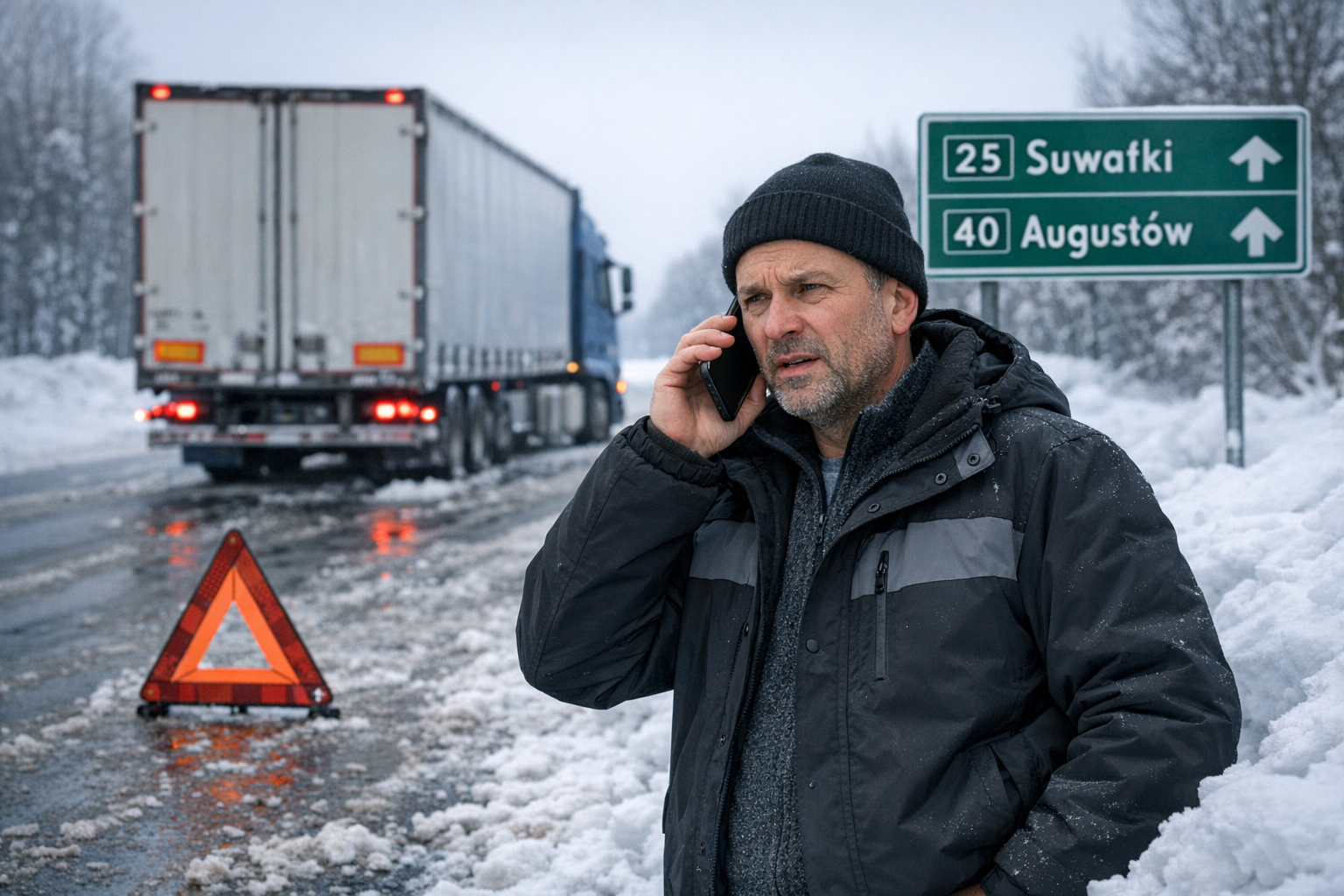
Anyone who has stood by the S61 route at night knows that a truck breakdown is not just stress and downtime – it’s a safety hazard and a real race against time. There’s the fear: „How long will this take?”, „Will anyone even come out to Filipów or Gawrych Ruda in the middle of the night?” Every carrier from Suwałki who has had to organize towing for heavy vehicles in winter knows the nerves that accompany a situation where a 40-ton set blocks the shoulder or lane. Especially when ice, snow, and temperatures of -20°C are involved. The truth is – it’s not just about the tow truck getting to the site, but the entire process: from the first phone call, through proper assessment of the situation, to effectively getting the truck back on its wheels or hooking it up to the tow truck. Sure, you might get lucky and call a random company from Białystok. But then you wait 3 hours, and the driver is furious because the trailer is blocking half the village.
Alright, let’s check what practically determines that towing a truck on the Suwałki–Augustów route goes smoothly, without costly surprises and wasted time.
Why does towing trucks require a completely different approach?
With a passenger car, it’s simple – sometimes just a few minutes and the car is on the tow truck. But an 18-meter set, often with a load worth tens of thousands of zlotys? No rope, no “quick tow truck,” just certified equipment and a team that has handled more than one truck in a ditch by the S61.
In Suwałki and the surrounding areas, we are most often called for:
– Road blockage by a truck that has slipped on ice
– Pneumatic system failures – without air, you can’t move
– Overturned trailers near the Mazurian Switzerland
– Fires in the engine compartment (February-March, two cases per week under Suwałki)
In 70% of cases, the key to quick towing of heavy vehicles is… the initial phone conversation. A real-life example:
Mr. Tomasz, a driver from Flextime Transport, got stuck on the S61 between Suwałki and Budzisk with a disabled DAF, cargo to Vilnius. When he called the nationwide Assistance hotline, he heard: “We will arrive in 2-3 hours, please wait.”
With us – within 5 minutes, the team was on the road, because during the conversation, we immediately learn about the type of gearbox, the condition of the cargo, and whether there are ADRs (dangerous materials) in the set, not “please wait.”
What else affects the time?
The first mistake: improper assessment of the situation by the “call center.”
The second issue – poor equipment location.
If the company sends a tow truck from Łomża, you lose at least 1.5 hours.
SKI TRANS keeps tow trucks on the Suwałki–Augustów route, and another point is north of the city, so realistically, getting to 80% of breakdowns takes us 25-45 minutes, even in winter.
Equipment makes a difference
Not every company has a vehicle that can tow 40 tons and has a low-bed platform for rescuing overturned trailers.
With us:
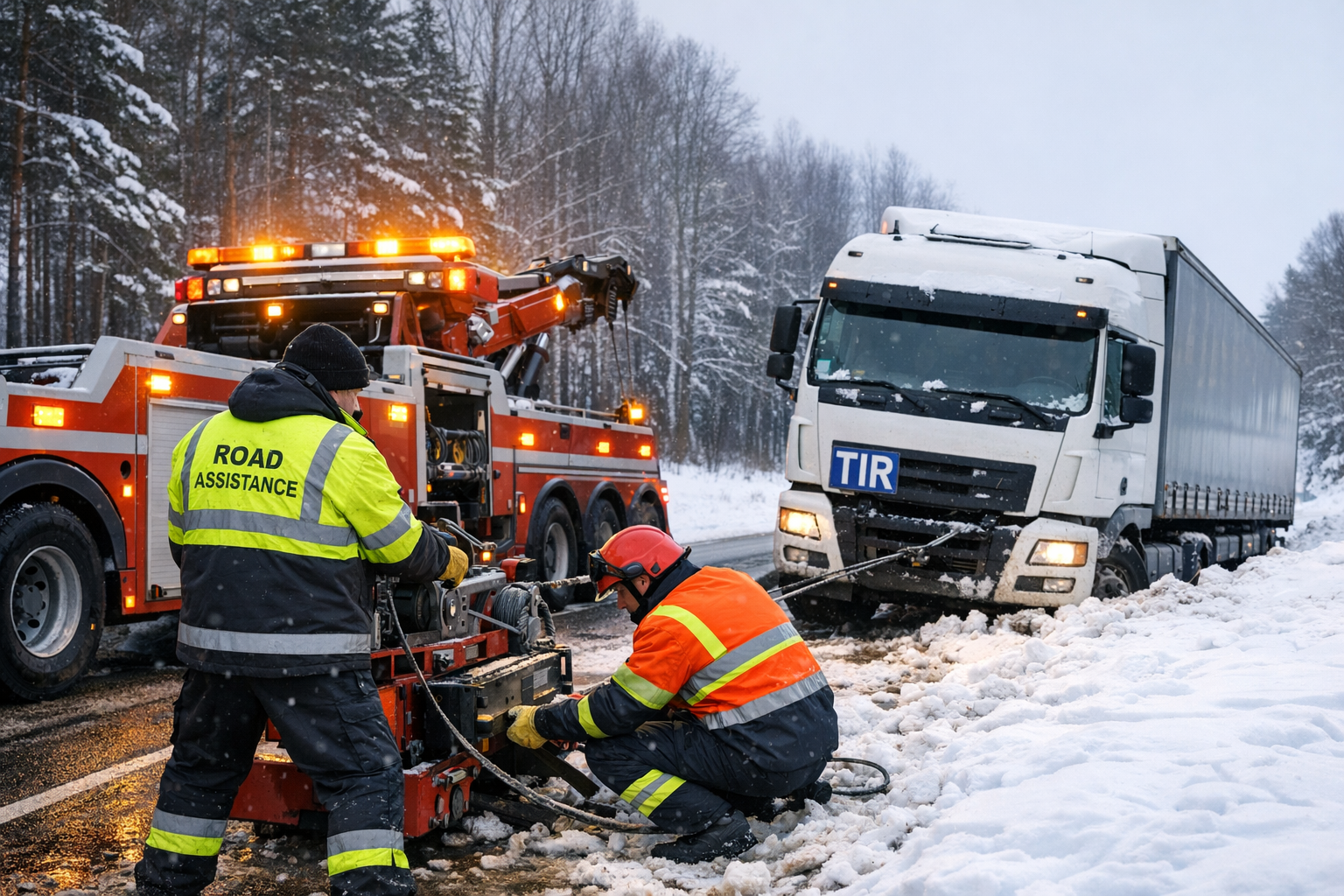
– MAN tow trucks with a capacity of up to 50 tons
– Hydraulic winches, securing straps (no ropes – that’s a fine and a risk for the set!)
– Systems for stabilizing trailers on ice
This doesn’t sound like an advertisement. It’s concrete: 9 out of 10 outings require winches; a regular tow truck won’t cut it here.
How does towing a truck proceed step by step?
The first thing – a quick diagnosis over the phone.
You need to know: brand/type of tractor, whether the set is complete, inquiries about ADR transport and police on site.
If, for example, we have a situation like in January on the route to Gawrych Ruda (a truck with electronics slid off an icy lane), immediately two teams:
– One sets up signage, warning lights
– The other approaches with a tow truck plus a “flatbed” just in case
In practice, 65% of actions start before the mechanic even leaves the office – because a good decision at the start = even 1.5 hours faster on site.
What are the most common truck breakdowns?
It’s not just about “something broke.”
In Suwałki and Podlasie, for 5 months of the year, the following dominate:
– Frozen pneumatics (at -20°C, just 20 minutes of standing still is enough)
– Dead batteries (in January, 3 cases a day)
– Blocked trailer brakes in the snow
In 30% of cases, the driver says: “I don’t know what happened – the vehicle won’t move, I hear hissing.”
And that’s why, before the tow truck even arrives, we ask:
“Is there hissing air when you turn the key? Do the lights come on normally? Do you see oil spots under the vehicle?”
We quickly sort out whether it’s a job on site or if we immediately hook the set to the tow truck.
Good interviewing is 40% of success
Over the phone, practical questions arise:
– „Is it a tractor unit or solo?”
– „How much does the load weigh?”
– „Is the trailer completely buried, or is it on its wheels?”
Based on this, we know whether one MAN will suffice or if we need to send two tow trucks and a winch.
Importantly: in 50% of cases, thanks to such interviewing, we immediately deliver parts (e.g., compressors, batteries – we always ask “Truck breakdown, what should we bring?”).
What makes a difference – a local team and communication on site
Mr. Marek from Giżycko had an unenviable situation – a load of fresh products, temperature -17°C, the vehicle got stuck on the shoulder near Filipów. A nightmare for the carrier, as everything depends on time.
To start, a quick consultation via Messenger and phone:
– Establishing the geolocation
– Notifying the authorities – because the truck was blocking a busy road
– Sending photos of the situation on site – to choose the strategy for entering the action
For the client, the difference is that they are not talking to a call center, but directly with the owner or mechanic who will actually go to the site.
We have no hidden fees for “length of route in Suwałki” or “night rate for tow truck pickup.”
In Suwałki and the surrounding areas, 8 out of 10 carriers ask before arrival:
– „What exactly will I pay for if you help lift the trailer?”
– „Does the transport of the set to the service include this assistance?”
We always respond: first diagnosis – then an open estimate for the specific case.
You can use roadside assistance even with issues related to documents or unusual cargo.
This is especially important when freight is coming from Lithuania or returning to the base in Suwałki.
Safety and response time are essential
Every day we see – drivers dream of just one thing: a quick return to work and no “unexpected surcharges.”
In 60% of situations on the S61, carriers complain:
– „The tow truck took 2.5 hours from Białystok.”
– „Upon arrival, they didn’t have the equipment to tow my type of vehicle.”
That’s why with us – equipment is ready under Suwałki, the team always has the qualifications for heavy towing, and clear communication from the first phone call.
How to avoid paying twice – practical tips for fleets and transport companies
Carriers from Suwałki ask the same thing:
How to avoid double costs? And is there a way to ensure that towing heavy vehicles doesn’t turn into a horror story with a bill 3000–4500 zlotys higher than expected?
A few proven tips:
– Always ask directly if the trip to the Suwałki–Augustów route is included
– Check if there are surcharges for “blocking the road” or “working in difficult conditions” in the price list
– Establish whether the team has equipment on site – not every tow truck has a broken drawbar or a complete set of winches
– Send photos of the set and the breakdown location – this usually shortens the action by even 30 minutes
– Check if they will deliver the necessary parts to the site if, for example, a compressor or valve fails
In the case of SKI TRANS, everything happens locally, so order towing, if something goes wrong on the route from Lithuania to Suwałki.
You can also call – even just for a consultation if you’re unsure whether it’s a pneumatic failure or a buried axle.
Why does local assistance mean less stress?
As statistics from Suwałki show, 65% of truck drivers who used our assistance then become our permanent clients.
The main reason? Relief after a quick intervention, specific information (“what is happening with your vehicle after towing?”) and avoiding unnecessary costs “from a boat or Warsaw.”
In practice – the driver is not left alone on the shoulder, does not waste time explaining with hotlines, but receives a simple message:
“The tow truck will be there in 35 minutes, we have everything on site – monitor your phone, provide your location.”
So what does this mean?
As you can see, in the event of a truck breakdown in Podlasie, more matters than just a hotline and the first random number from Google.
Quick, professional towing of heavy vehicles depends on a local team, modern equipment, and a conversation with someone who really knows the Suwałki–Augustów route.
It’s not worth risking long downtimes or double charges for a company coming from the other end of the province.
If you’ve ever had a situation like “I’m stuck at night, no one is answering, I urgently need roadside assistance for heavy vehicles on the S61,” save this number:
SKI TRANS Road Assistance – Suwałki and surrounding areas, phone +48 608 275 667. We operate 24/7, with no hidden costs, always transparently.