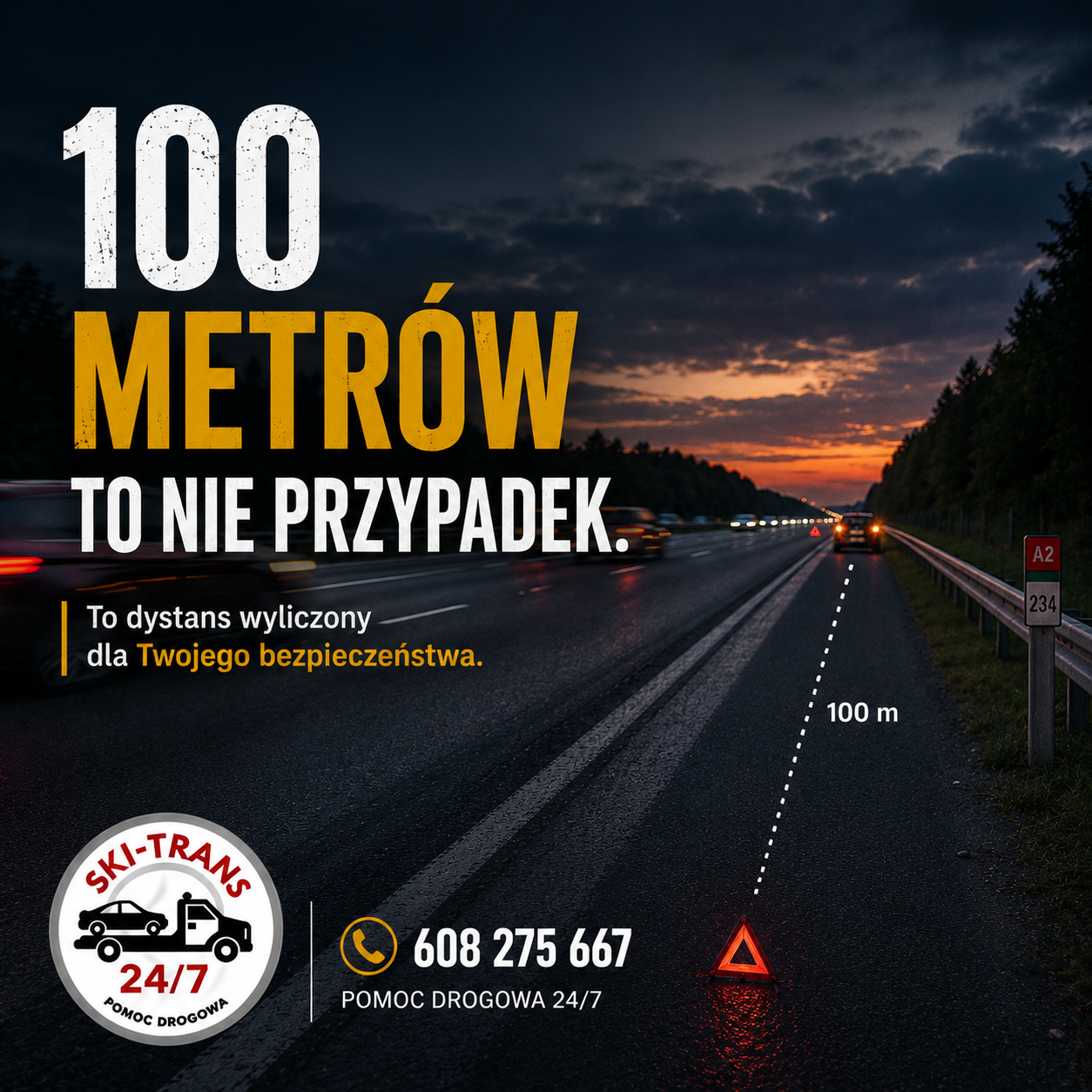
The shoulder of the highway is not a parking spot — it’s an area where every second counts for life. 100 meters behind the vehicle is not a bureaucratic invention from a tariff. It’s the distance that gives other drivers a chance to notice an obstacle and react before driving straight into a stationary car. It’s also the distance you need to walk to set up a triangle — on foot, along the emergency lane, with a car speeding by at 140 km/h. In this article, we explain exactly how the regulations on signaling a stop work, why the police return to this topic several times a year in their communications, and what to do in the first minutes after a breakdown — first on the highway, then on regular roads, and in the city.
100 meters — a number that really matters
The obligation to signal a vehicle stop due to a breakdown or accident is regulated by Article 50 of the Road Traffic Law. The regulation is precise and differentiates requirements based on the type of road.
| Type of road | Distance of the triangle | When it applies |
|---|---|---|
| Highway or expressway | 100 m behind the vehicle | Always, in every case of a stop due to a breakdown or accident |
| Road outside built-up areas | 30–50 m behind the vehicle | When the stop is in a prohibited place or on the shoulder, if the vehicle is not visible from a sufficient distance |
| Built-up area | Directly behind the vehicle or on it (max 1 m high) | When the stop occurs in a place where stopping is prohibited |
Why exactly 100 meters on the highway? Because it’s roughly the distance at which a driver traveling at 140 km/h can safely react — notice an obstacle, slow down, change lanes. It’s not a symbolic value — it corresponds to the physics of traffic movement.
What happens to a car speeding at 140 km/h
The human brain needs about 1 second to react to an unexpected situation on the road — that’s the reaction time from noticing an obstacle to pressing the brake. At a speed of 140 km/h, the car covers over 38 meters in that one second. The braking distance (from the moment the brake is pressed to a complete stop) on dry, good pavement is over 150 meters — this is the data provided by the Municipal Police Headquarters in Częstochowa. Including the reaction time, the driver needs nearly 190 meters to stop the vehicle. On wet surfaces, this value can double.
This means two things. First: a triangle 100 meters behind the vehicle is an absolute minimum, not a buffer. Second: every fraction of a second of distraction — a driver looking at their phone, checking navigation, talking to a passenger — translates into additional meters during which the car does not stop.
Procedure on the highway and expressway
The sequence of actions after a breakdown or collision on the highway differs significantly from the procedure on a regular road. Every step is justified by the physics of motion at a speed of 140 km/h.
- Turn on the hazard lights immediately, when you notice a problem — loss of power, strange noises, vibrations in the steering wheel. The sooner, the more time you have to move off the lane.
- Move to the emergency lane as far away from the traffic lane as possible, preferably right next to the crash barrier. Turn on your right turn signal while entering the emergency lane — you are signaling your maneuver.
- Put on a reflective vest EVEN IN THE CAR, before opening the doors. Opening the doors without a vest makes you invisible to approaching drivers — especially at night and during rain.
- Check the side mirror before getting out. Opening the door towards the traffic lane when a vehicle is approaching from behind is a classic scenario for a fatal collision. Exit from the roadside.
- All passengers exit behind the barrier. Children, elderly people, pets — everyone. No one stays in the car. No one stands by the car.
- Place the triangle 100 meters behind the vehicle. Walk along the emergency lane, but if possible — behind the crash barrier. Hold the triangle in front of you — it informs why you are walking along the roadside.
- Wait for help behind the barrier, not by the car, not in the car. This is the safest place — even if someone hits your car, you will be outside the impact zone.
- Call for roadside assistance or 112. Provide the road number, direction of travel, and the number from the milestone post — that’s enough for the services to arrive without getting lost.
Breakdown on the S61, Via Baltica or the roads of Suwałki?
SKI TRANS — roadside assistance Suwałki with a dispatch center 24/7. Towing, fuel delivery, extraction from a ditch. Service for highways, expressways, and national roads in the region.
The three most dangerous mistakes drivers make on the roadside
Accident analyses on highways conducted by the Chief Police Headquarters regularly point to the same causes of tragedy — mistakes made in the first minutes after a breakdown. All three are avoidable without any additional tools or skills.
Mistake 1: Exiting the car without a reflective vest
A reflective vest is not an accessory. It makes the difference between “visible from 100 meters” and “invisible until the last moment.” A driver in dark clothing, standing next to a dark car at night or in the rain, is practically indistinguishable from shadows. The vest should be put on before opening the doors — not after exiting, not after approaching the trunk, not after reaching the triangle. All passengers as well.
Error 2: Staying in or near the vehicle
The most common instinct after stopping on the emergency lane: I stay in the vehicle, wait for help, turn on the radio. This behavior is responsible for most tragedies in the statistics. A vehicle standing on the emergency lane is a target for any tired, distracted, or sleepy driver. The safe zone is the space behind the crash barrier — a physical barrier between you and oncoming vehicles.
Error 3: Attempting repairs on the emergency lane
Opening the hood, changing a tire, checking the oil level while the vehicle is on the emergency lane of the highway — these actions are safe on regular roads, but become a gamble on the highway. Roadside assistance will not only change the tire — primarily, they will do it after safely loading the vehicle onto a tow truck or with proper signage at the work site. Waiting 20 minutes longer for a specialist costs less than the consequences of an accident.
The shoulder of a regular road and built-up area
On national, provincial, county, and municipal roads, lower speed limits apply (90 km/h outside built-up areas, 50 km/h in built-up areas), so distances and procedures are less dramatic — but the basic rules remain the same.
Outside built-up areas
- Warning triangle placed 30–50 meters behind the vehicle
- Reflective vest mandatory when exiting the vehicle
- Hazard lights turned on (or position lights if the vehicle does not have hazard lights)
- Passengers move away from the roadway — preferably behind a field, ditch, or barrier
- Stopping outside the traffic lane, if possible — usually just the shoulder is sufficient
In built-up areas
- Triangle directly behind the vehicle or on it, at a height not exceeding 1 meter
- Reflective vest is not mandatory but recommended, especially after dark
- Hazard lights turned on
- If the vehicle blocks the passage — possible consequences for obstructing traffic (Article 90 of the Offenses Code, fines from 500 PLN to 5000 PLN)
Remember that on roads outside built-up areas, traffic is often lighter, but speeds are higher than in the city. A vehicle entering a national road from a county road, a driver traveling at night after a long day, a truck after an hour of fatigue — these are all real threats that you cannot control. You can only make yourself and your vehicle as visible as possible.
What statistics say — and what they don’t say
Statistics from the Chief Police Headquarters for 2025 show a picture of Polish roads in numbers.
Traffic accidents in Poland, KGP data for 2025
- A total of about 21,000 accidents
- 1,651 fatalities
- 24,715 injured
- Compared to 2024: 519 fewer accidents, 245 fewer fatalities
Poland has introduced stricter traffic regulations, a fine tariff, and penalties for serious offenses. These actions have led to a decrease in the number of accidents — the European Commission has indicated Poland as the country with the largest decrease in road traffic fatalities in the EU over the last five years.
What the statistics show less clearly: the distribution of accidents by road category. The vast majority of incidents (over 90%) occur on two-way and dual carriageway national, provincial, and county roads. Highways and expressways account for only a few percent of all accidents. This is good news — highways are statistically much safer than regular roads. But if an accident occurs on the highway, its consequences are often more severe, and the driver’s behavior after a breakdown or collision is crucial for saving lives.
FAQ
The regulation states a 'sufficient distance’ of about 100 meters on highways and expressways. In practice, the police accept values around this number — 90 meters or 110 meters, if conditions require it. However, placing a triangle 30 meters behind a vehicle on the highway is a clear violation and — more importantly — a dangerous situation for everyone. The safest way to determine the correct distance: reach the nearest white milestone behind the vehicle (they are set exactly every 100 m).
Drive onto the emergency lane as far as possible. The emergency lane on the highway is 3 meters wide, and on the expressway, it is 2.5 meters (on a single-lane S it can even be 2.0 m) — in both cases, it is enough for a passenger car to fit with a margin from the traffic lane. If you cannot reach the emergency lane (for example, the breakdown was so sudden that the car is partially in the traffic lane), turn on the hazard lights, evacuate everyone from the car on the safe side, move away as quickly as possible behind the barrier, and call 112. In such cases, the authorities will close the traffic lane to avoid a secondary accident.
The triangle must be visible to drivers coming from the direction they are approaching. On a curve, this means placing the triangle before the bend — sometimes further than 100 meters behind the vehicle, but in a spot where drivers will see it before entering the curve. The purpose of the regulation is visibility, not a rigid distance. Milestones help to determine where the straight section ends before your vehicle.
Yes, although this is the least pleasant moment of the entire procedure. Walk along the edge of the emergency lane, as far away from the traffic lane as possible, preferably behind the crash barrier if the terrain allows. Hold the triangle in front of you as a warning element — signaling to other drivers why you are walking on the emergency lane. Place the triangle on the line separating the emergency lane from the traffic lane (i.e., at the very edge of the emergency lane facing the traffic), not by the barrier — that way it is best visible.
Everyone gets out of the car. Children first — preferably from the safe side (the shoulder, not the traffic lane), holding their hands. Pets on a leash or in a carrier. Then evacuate behind the crash barrier and wait for help together in a safe place. Leaving anyone in a car standing on the highway is a risk not worth taking, even if the weather is rainy or the temperature is high.
For not having a triangle in the vehicle’s equipment — a fine from 20 to 500 PLN. For improper use of the triangle (e.g., placing it 30 m behind the vehicle on the highway), the police may treat it as not signaling a stop according to Article 50 of the Road Traffic Act — a fine also up to 500 PLN. But in practice, drivers face a much more serious risk than a fine: without a properly displayed triangle, an approaching vehicle does not know about the danger in advance.
The roadside assistance team secures the scene with their own markings (warning lights of the tow truck, additional cones or triangles, and if necessary, closing the lane in cooperation with the police). They then assess the possibility of starting the vehicle on-site or the need for towing. Passengers remain behind the crash barrier until the loading is completed — they only get into the tow truck’s cabin when the car is safely secured on the platform.
Roadside Assistance Suwałki — safe help 24/7
SKI TRANS — 24/7 dispatch, local tow truck, HDS crane arm. Suwałki region, Via Baltica route, S61, border with Lithuania. Communication in PL/EN/RU/DE.