
Jump-starting with cables – safe order, common mistakes, and when to call for help
In Suwałki, -15°C at seven in the morning is not a theory – that’s what real life looks like in January. I know this from conversations with drivers who call us at SKI TRANS Road Assistance, frozen and irritated when their car won’t start after a frosty night. Sometimes they try to 'jump-start with cables’ themselves, sometimes even with the help of a neighbor from the block on Noniewicza. And that’s where it begins – either successfully, or it ends with a dead second battery, burned cables, and even more stress.
The truth is: in a city where winter can show its claws, most emergency calls are indeed for 'jump-starting with cables’. But among those who try it themselves, as many as 6 out of 10 make basic mistakes: they confuse the order, use cables that are too thin, and sometimes… connect them the wrong way. The result? Short circuit, sparks, electronic failure, and sometimes even fire. So let’s see what to do to jump-start a car with cables effectively and safely. When is it better to give up and call for help before you get yourself into trouble worth thousands of zlotys?
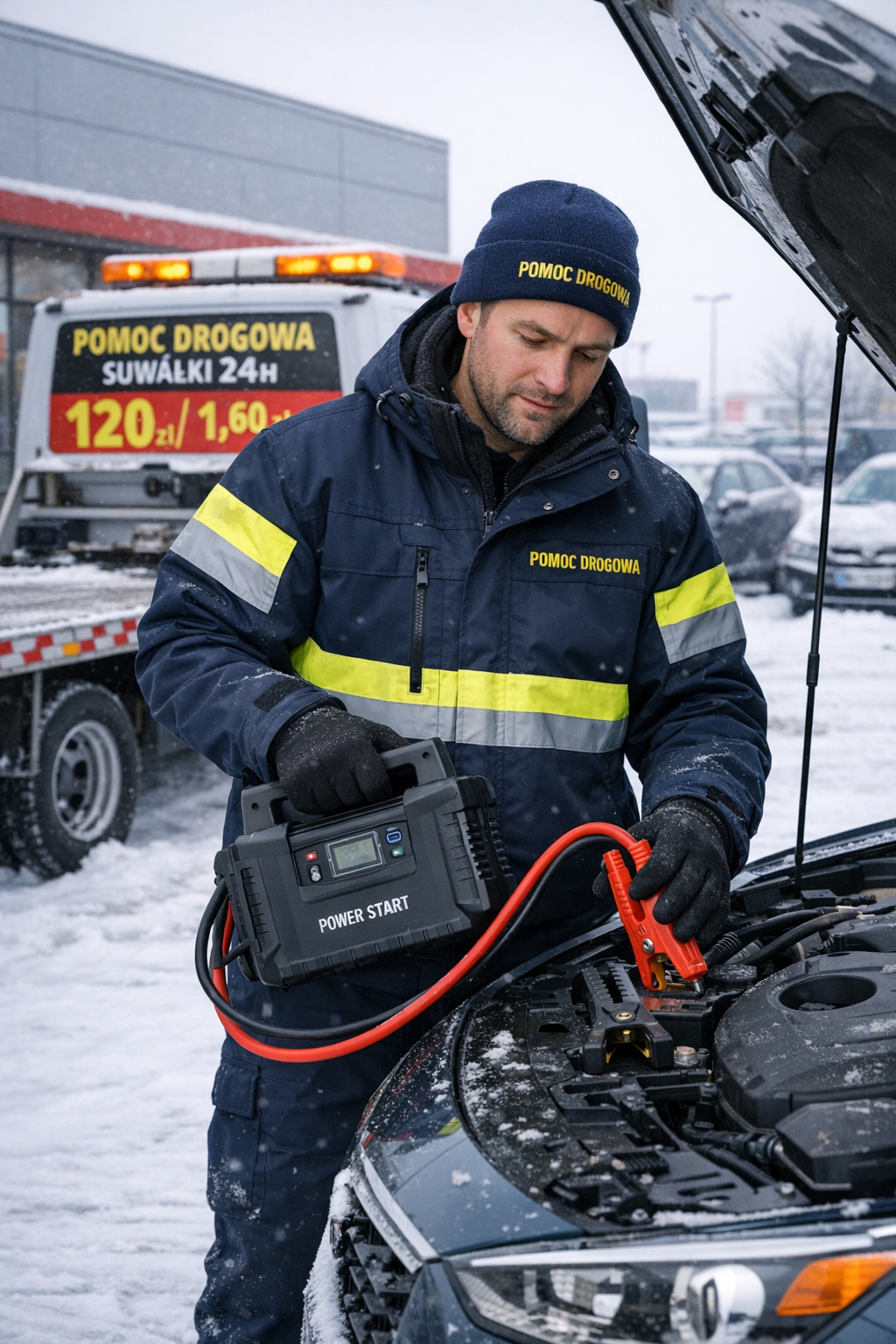
How to jump-start a car with cables – step by step, in simple terms
From a theoretical point of view, everything seems simple. You take the cables, connect them, turn the key. In practice, the devil is in the details. In Suwałki, in winter, the battery loses up to 45% of its power – this is not the time for experiments.
Check if you can even jump-start with cables
Before you start, make sure you have the right set of cables – at least 16 mm² thick (those from the store for 30 zlotys that are as thin as twine are not a good idea). You also need a second car with a battery in good condition and a similar engine capacity – so if you have a diesel, don’t connect to a small car.
Alright, and also: there should be no damage under the hood, no leaking coolant, or smoke! If there are, give up and call for professional roadside assistance – don’t risk fire or short circuit.
Order of connecting the cables – don’t make a mistake!
This is where most people make mistakes. The order for jump-starting with cables is as follows:
- Red cable (positive) to the PLUS on the dead car
- The other end of the red cable to the PLUS on the donor car
- Black cable (negative) to the MINUS on the donor car
- The other end of the black cable to a metal part on the dead car (preferably the engine block, not directly to the battery’s negative!)
Yes – connect the MINUS somewhere to the ground, preferably a bit away from the battery. Don’t ask why, it’s just safer – fewer sparks, lower risk of gas explosion from the battery. Every good mechanic from Suwałki knows this rule.
What next? Starting and disconnecting
First, start the donor car for about 3-5 minutes (or give it a little gas in neutral). Then try to start your car. When it catches, don’t turn it off immediately! Let it run at idle for 10-15 minutes to charge the battery a bit.
Disconnect the cables in the reverse order to how you connected them. First, the black from the ground, then from the negatives, then the red from the positives. And you’re done.
When is it better not to jump-start by yourself? Examples from Suwałki and Podlasie
I’ve seen cases where Mr. Tomek from near Gawrych Rudy burned out the onboard computer because he connected the cables the wrong way. Cost of repair? 2800 zlotys, and he could have called us, spent 100-200 zlotys, and had peace of mind and certainty.
Don’t try jump-starting with cables if:
- The battery has leaked or is physically damaged
- The 'check engine’ light is on after trying to start or you hear a loud 'click’ instead of the starter turning
- You have a hybrid/electric car – there, you can’t always use classic cables!
- Your car has very advanced electronics (some new cars, e.g., Mercedes, VW Passat from 2013) – you could damage sensors, with repair costs in Suwałki ranging from 500 to even 5000 zlotys
Seasonal example? At the end of February, minus 20°C, Suwałki, parking lot by Lidl. A client tried three times, the battery was already 'fried’, then called us – and not only was the battery dead, but the starter also needed replacement. Better to call early before the problem worsens.
Most common mistakes when jump-starting with cables – and what they lead to
Before you rush into action, you need to know what to do and – equally important – what NOT to do. Here’s a list of 'classics’ that we often see during operations on the Suwałki-Augustów route:
- Cables that are too thin – they won’t carry the current, the cables melt, you won’t start the car
- Incorrect order – the worst, because you could cause a short circuit, burn your hands, or damage the electronics
- Connecting negatives 'to negative’ – this is where sparks and gas explosions from the battery come from
- Disconnecting cables while the engine is running (instead of first turning off the donor) – sudden voltage spikes can damage the engine computer
- Jump-starting in ignition mode (instead of starting the donor engine) – zero effect, sometimes burns out the switch or fuses
The biggest sin? Prolonging the issue. If after a few attempts the car still only makes a 'click’, don’t try to fix it – in 65% of cases, this means the battery is dead. It’s better to order professional jump-starting with cables with diagnostics and proper equipment.
Remember about your own safety and that of your car
Never smoke or use an open flame when connecting cables. Batteries emit hydrogen, and at -20°C under the block in Zielone housing estate, you can sometimes even see liquid electrolyte. If you have doubts – don’t risk your health and your car.
Professional jump-starting with cables – when SKI TRANS is your rescue
There are situations when driving around the parking lot with cables just doesn’t make sense. Does your car have a new generation OBD diagnostic socket? Do you drive on gas or have an automatic? Or are you trying to start in the open field near Suwałki, with wind and a snowstorm?
Then it’s best to order emergency jump-starting in Suwałki through SKI TRANS. We will arrive with a tow truck or service vehicle, with 25 mm² cables, boosters, a battery tester, and connections that won’t risk damaging the electronics.
Thanks to this:
- Response time – even 20 minutes in the center of Suwałki, 30-40 minutes to Gawrych Rudy or on the way to Augustów
- No hidden costs – pricing is always given over the phone, according to the real situation (sometimes just 'tightening’ is enough, sometimes a battery replacement or comprehensive diagnostics is needed)
- Safety – no tinkering with electronics without knowledge; you can be sure that the car will start without damaging the controllers
- Local team, always 24/7 – even in the middle of a winter night, when other companies are asleep or hundreds of kilometers away from Suwałki
Tourists calling from the E67 route appreciate that we are faster than any assistance chains from Warsaw. We don’t have a call center, just a specific number – you will connect immediately.
Do you always have to jump-start with cables?
No! Sometimes the issue lies with the starter, sometimes with the immobilizer, sometimes you fill up with the wrong fuel – and then even the best cables won’t start the car. In over 30% of December incidents in Suwałki, our team diagnoses issues that are more complicated than just a 'dead battery’. We immediately know whether it’s worth trying again or better to take it to the workshop.
How to prepare your car for winter and not be caught off guard – preventive tips
This is not coaching, just experience: 8 out of 10 winter breakdowns in Suwałki can be predicted and eliminated! The key points are:
- Monitor the battery – if it’s 4-5 years old, it’s better to replace it before winter than to mess around with jump-starting in the frost
- Regularly check the terminals and cables – every two weeks, take a look under the hood, especially before major frosts
- Keep good cables in the trunk – at least 16 mm², preferably 25 mm² with solid clamps
- Emergency jump-starting in Suwałki saves the day, but it’s better not to have to call it in the middle of the night
- Don’t wait until the car starts 'cranking but not starting’ – that’s already a sign that the battery is on its last legs
It’s better to be cautious. A battery check at a local workshop in Suwałki costs less than 50 zł. A new battery for a typical diesel – from 350 zł upwards. And a tow truck or 'booster’ in the middle of the night – often over 100 zł plus stress and nerves.
What does this mean? Reliable help or experiments – the choice is yours
Jump-starting with cables is not black magic, but it requires precision and feel. If you have even a hint of doubt: don’t guess, don’t rely on luck, just call us. SKI TRANS Road Assistance operates in Suwałki and the surrounding areas 24/7 – quickly, fairly, and with a local 'approach’.
Are you standing under a block in Osiedle Północ, on the city’s exit road, or on the route near Gawrych Rudy and the frost reaches -20°C? Don’t mess around – call +48 608 275 667. We will always advise you whether you can try on your own or if it’s better to order emergency jump-starting in Suwałki. No stress and no risk! #RoadAssistanceSuwałki #JumpStartingWithCables