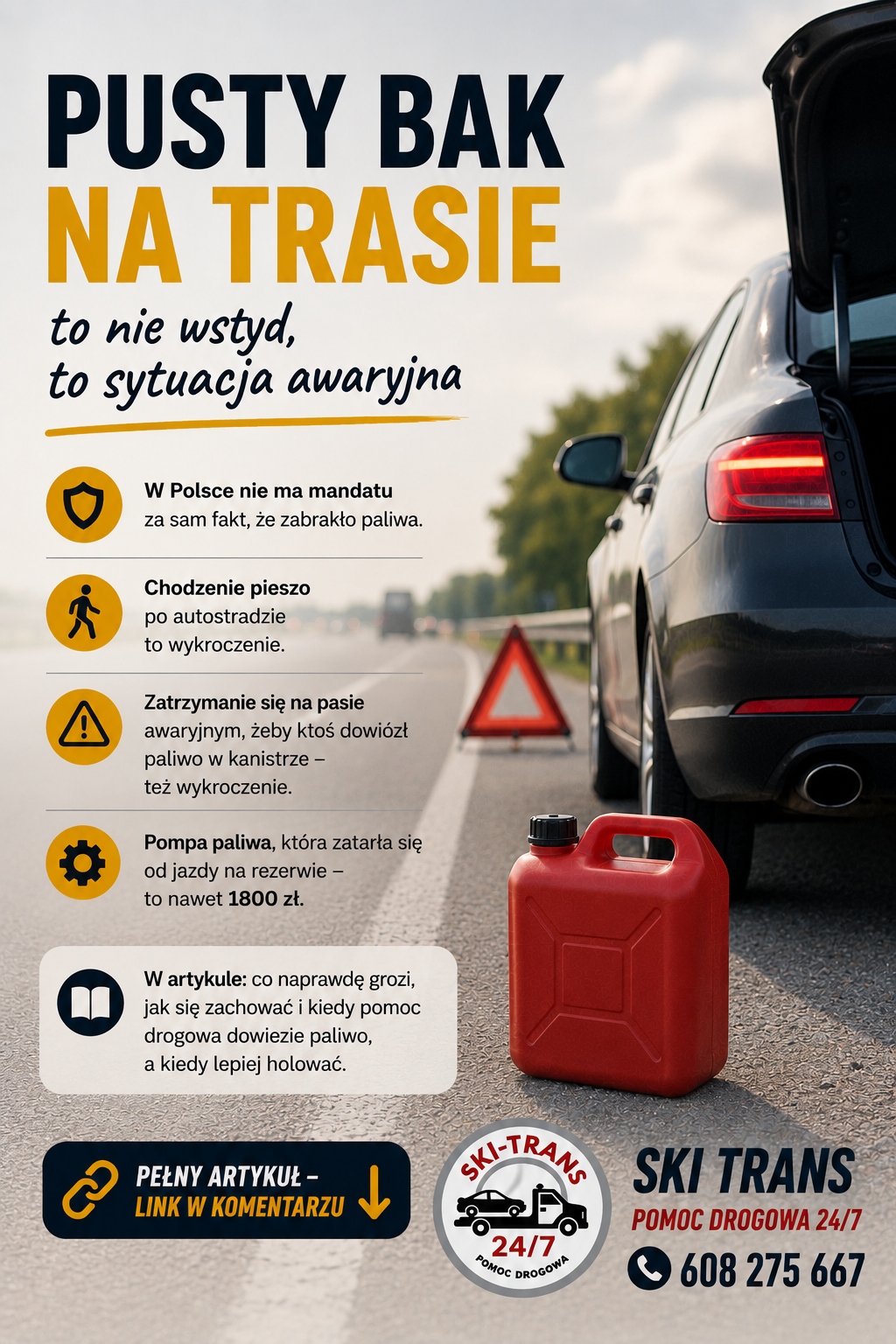
An empty tank on the road is not a shame — it’s an emergency situation that happens to thousands of drivers each year. Contrary to repeated myths, Polish law does not have a separate fine for simply running out of fuel. However, if you stop your car in the wrong place or try to handle the situation yourself on the highway, a fine will be issued. On top of that, there are hidden costs: a fuel pump for 1800 PLN, an air-locked fuel injection system in a diesel for several thousand. In this article, we show what really threatens you, how to behave, and when roadside assistance will deliver fuel, and when it’s better to tow the car to a workshop.
Is there a fine for an empty tank in Poland?
Short answer: no, there is no separate paragraph in the Polish fine schedule for simply running out of fuel.Unlike in Germany, where stopping a car due to an empty tank on the highway costs about 35 euros, and a stop longer than 3 minutes incurs an additional 70 euros. In Poland, the police will not issue a fine for your car standing with an empty tank.
The problem is that an empty tank is rarely a 'clean’ offense — it is usually accompanied by other situations that already warrant a fine:
What it can really cost you
- Obstructing or hindering traffic (Article 90 of the Offences Code) — a fine from 500 PLN to 5000 PLN. It is enough for your car to stop in a place that blocks passage or creates a hazard.
- Walking on the highway or expressway — pedestrians are prohibited from moving on these roads. Classified as an offense under Article 97 of the Offences Code (fine up to 3000 PLN) or Article 90 of the Offences Code (hindering traffic) — the police decide on a case-by-case basis.
- Stopping on the emergency lane to add fuel from a canister — the emergency lane is meant for stopping a vehicle in case of breakdown, not for transferring fuel from another car. Stopping in a prohibited area is an offense.
- Improper vehicle marking — lack of a triangle, reflective vest outside built-up areas, and not turning on hazard lights is also an offense.
What happens to the car when it runs out of fuel
Driving 'on an empty tank’ is not just a matter of stopping — it is often the moment when costly repairs begin.
Gasoline — overheating the fuel pump.
In gasoline engines, the fuel pump is located inside the tank and is cooled and lubricated by the same fuel it pumps.When the fuel level drops extremely low, the pump has nothing to cool itself with, starts drawing air from the bottom of the tank, and overheats. In extreme cases, this can lead to seizure.
Replacing the fuel pump costs from several hundred to about 1800 PLN for the part alone, plus several dozen to two hundred PLN for labor. The problem begins when a seized pump spreads metal shavings throughout the fuel system — then cleaning the tank and replacing filters are necessary, and in extreme cases, injectors may also be damaged.
Diesel — air in the Common Rail system
In vehicles with a diesel engine, the situation is even worse. When the tank is emptied completely, air enters the fuel system. The Common Rail (a common injection system in modern diesels) reacts to air with irregular engine operation, difficulties starting, and loss of power.
Worse yet: driving with a minimal fuel level in a diesel can lead to the seizure of the injection pump.Metal shavings from the seized pump can pass further to the injectors. Each of these components costs thousands of PLN. Reconditioning the injection pump at a specialized service usually costs from several hundred PLN in simple cases to several thousand in more difficult ones. A single Common Rail injector — from several hundred to over a thousand PLN each.
What to do on a regular road when you run out of fuel
The procedure on a national, provincial, or county road is relatively simple — you have more freedom than on a highway, but safety still needs to be maintained.
- Turn on your hazard lights immediately, when you feel the engine losing power. The onboard computer often signals an impending fuel shortage earlier than the engine actually stops.
- Coast your car to the shoulder using inertia — preferably rolling down a slope if possible. The further from the traffic lane, the safer it is.
- Place a warning triangle — on a regular road at a distance of 30–50 meters behind the vehicle (a requirement for undeveloped areas).
- Wear a reflective vest — mandatory outside built-up areas when exiting the vehicle.
- Move away from the roadway. Stand on the field side, not on the traffic side. Every approaching car is a potential threat.
- Call for roadside assistance. The dispatcher will ask for your location (road number, kilometer, nearest town, preferably GPS coordinates from your phone), type of fuel, and how much you need.
In built-up areas, the caution threshold is lower — the triangle can be placed directly behind the vehicle or on the vehicle in a visible spot, and the reflective vest is not mandatory. But the rule 'move away from the roadway and wait for help’ applies everywhere.
Emergency lane on highways and expressways — what not to do
Here the rules are much stricter, and mistakes are much more costly. Highways and expressways are environments where vehicles travel at 120–140 km/h, and any surprise on the emergency lane can end in a serious accident.
- Use the emergency lane ONLY if necessary. Enter it as smoothly as possible, as far from the traffic lane as possible — right next to the barrier if possible.
- Hazard lights, right turn signal already while entering the emergency lane.
- Reflective vest put on STILL IN THE CAR, before opening the doors. On the highway, exiting the vehicle without a vest is a risk not worth taking.
- Warning triangle placed 100 meters behind the vehicle (a rule for highways and expressways).
- Passengers evacuate from the safe side — that is, from the roadside, not the traffic lane. Everyone goes behind the barrier.
- Waiting for help — behind the crash barrier, never on the emergency lane or in the vehicle (if the vehicle is close to traffic).
1. Walk on the emergency lane or roadway — pedestrians are prohibited from moving on highways and expressways. Just walking is an offense, and there is also a deadly risk involved.
2. Walk to the nearest service area for fuel — that’s still “walking on the highway”.
3. Ask a friend to bring a canister and stop on the emergency lane — that’s stopping a vehicle in a prohibited area, which is an offense. Fuel delivery to the highway is safely and legally performed by roadside assistance as part of a rescue intervention.
Empty tank? Don’t hesitate — call
SKI TRANS — roadside assistance Suwałki, dispatch 24/7. Fuel delivery, towing to the nearest station or workshop. Service in Suwałki region, Via Baltica route, S61, national roads.
What does roadside assistance do — fuel delivery or towing
Roadside assistance has two basic options in case of running out of fuel. The choice depends on the type of car, how much fuel is missing, and whether the fuel system has become airlocked.
| Situation | What does roadside assistance usually do | Why |
|---|---|---|
| Gasoline, empty “since a moment”, engine stalled without prior symptoms | Delivery of a fuel canister, adding a few to several liters, attempt to start the engine | The fuel pump usually starts after adding fuel if it hasn’t run dry for too long |
| Gasoline, long smoke from the tank, engine stalled and restarted, finally won’t start | Attempt to add fuel and start; if the engine doesn’t run smoothly — towing to the workshop | Possible damage to the pump or contaminants drawn from the bottom of the tank |
| Diesel, empty 'since the moment’ | Refueling and bleeding the system on-site (if the vehicle has a manual priming pump) | In many modern diesels, bleeding the system requires a diagnostic computer — then towing is necessary |
| Diesel, engine won’t start despite added fuel | Towing to the workshop | Common Rail is airlocked, service procedure required |
How much fuel can roadside assistance bring
Transport of fuel in canisters in Poland is regulated by regulations ADR agreements (European agreement concerning the international carriage of dangerous goods by road). For private individuals, the limits are as follows:
ADR limits for private individuals
- Maximum capacity of a single canister: 60 liters
- Maximum amount of fuel in the vehicle: 240 liters
- The canister must be certified for fuels (UN marking), sealed, secured against movement
- Plastic bottles, buckets, containers from household chemicals are prohibited
Roadside assistance operating as part of a rescue intervention benefits from ADR exemptions provided for rescue services. In practice, for typical deliveries on the route, 5–20 liters is usually enough (to reach the nearest station), so the issue of limits concerns more the supply of the base than a single action.
How not to find yourself in this situation
The rules are simple, but many drivers break them for seemingly rational reasons (fuel is cheaper at another station, 'I’ll make it’).
Practical habits that work
- Refuel when the reserve light comes on — do not ignore it, because the onboard computer shows 'still 50 km’. These are estimates, not guarantees
- Check the fuel level before entering the highway or expressway — the distances between stations on the S61 or Via Baltica can exceed 30–40 km, closed stations are common at night
- In winter, refuel earlier — low temperatures promote the precipitation of paraffin in diesel fuel, especially at minimal levels in the tank. The result is a clogged filter and a seized pump
- On long trips, plan breaks — preferably every 2-3 hours, while refueling, even if there is still plenty of fuel
- Starting a trip with a full tank, you know you usually have a range of 600–900 km — with an empty tank, you only know you’ll stop soon
FAQ
It depends on the car — usually, the reserve is about 8-12% of the tank’s capacity, which translates to 30-80 km. But these are theoretical values for a constant speed and flat terrain. In traffic jams, uphill, with the air conditioning on, or when driving fast, the range can be significantly shorter. The best rule: when the light comes on, refuel at the nearest station, don’t look for a cheaper one.
A friend cannot stop on the emergency lane to hand over a canister — that is stopping a vehicle in a prohibited area, which is an offense in itself. The emergency lane is for stopping a vehicle in case of breakdown, not for transferring fuel. The legal procedure is to call roadside assistance, which operates on the emergency lane as part of a rescue intervention.
Yes — in a certified canister (marked UN), with a capacity of up to 60 liters, totaling up to 240 liters of fuel for a passenger vehicle. Plastic bottles, buckets, or non-certified containers are prohibited. The canister must be secured to prevent movement in the trunk. Remember that a full canister of gasoline in a hot trunk poses a real fire hazard — many gas station owners refuse to fill containers without certification.
This is a high-priority emergency situation — immediately turn on the hazard lights, stop the vehicle as close to the edge as possible, everyone exits and evacuates to a safe place (outside the tunnel, behind barriers on the bridge). Then call emergency number 112 — in tunnels and on engineering structures, the operation must be coordinated with the appropriate services. Roadside assistance will be called by the 112 dispatcher if necessary.
It depends on the policy. Most assistance packages as an extension of liability or comprehensive insurance include fuel delivery as one of the services — but there are limits (usually a limited number of interventions per year, the cost of fuel is the driver’s responsibility). Some policies exclude running out of fuel from assistance as a 'breakdown caused by driver error.’ Check your policy before calling — sometimes the insurer requires a request through their headquarters, not a self-selected company.
In a gasoline engine, this usually means that the fuel pump has sucked in air and requires several attempts (turning on the ignition without starting, waiting, trying again). In a diesel engine, the situation is more serious — Common Rail requires bleeding, which in newer cars must be done from the engine control unit using a diagnostic computer. In both cases, if attempts on-site do not help, the only option is to tow to a workshop — continuing attempts to start may lead to a drained battery.
The price depends on the company, location, and time of day. Typically, the cost consists of: tow truck travel (rate per kilometer from the base), service fee for the intervention itself, delivered fuel (at the station price, sometimes with a markup). Night and weekend interventions are 20-40% more expensive. The best rule: call the dispatcher, provide the exact location and type of fuel, and you will receive a quote before sending a team.
Roadside assistance Suwałki — fuel delivery and towing 24/7
SKI TRANS — 24/7 dispatch, fuel delivery, towing to the nearest station or workshop. Suwałki region, Via Baltica route, S61, border with Lithuania. Communication PL/EN/RU/DE.