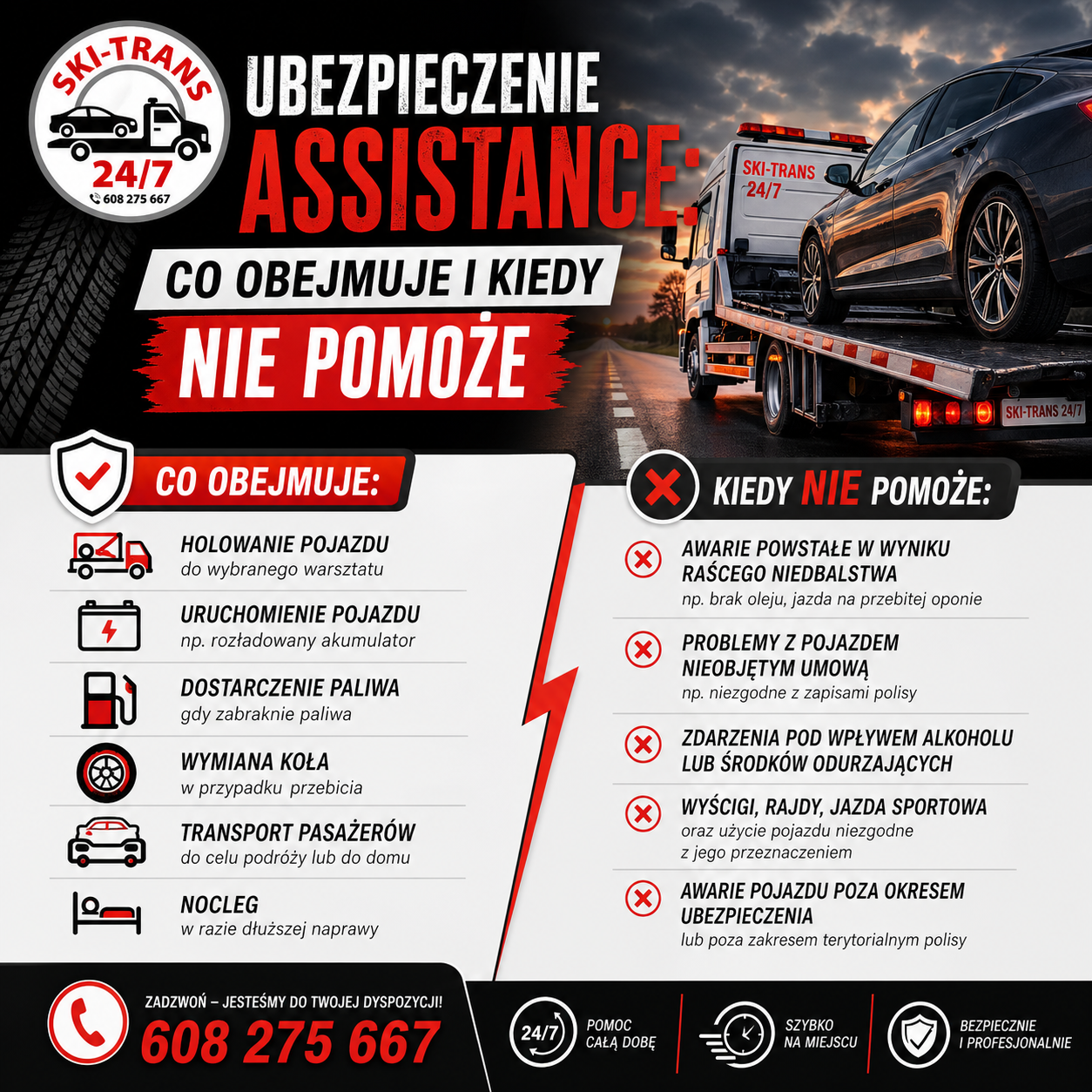
Assistance insurance is an additional policy that provides roadside assistance in case of breakdown or collision — towing, on-site repairs, fuel delivery, a replacement car, or accommodation. However, what is crucial is not what it covers, but what it DOES NOT cover. The list of exclusions can be long, and most drivers discover it only when the hotline operator refuses assistance.
What is assistance insurance and how does it work
Assistance is roadside assistance insurance that is activated in the event of a breakdown, collision, or other situation immobilizing the vehicle. After reporting to the insurer’s hotline, the operator verifies the scope of coverage, locates the nearest partner (a roadside assistance company cooperating with the insurer), and sends help to the location.
The mechanism seems simple: you call, provide your policy number, describe the situation, and wait. In practice, each of these steps can become complicated — the operator may refuse assistance, the partner may have a long response time, or it may turn out that your situation is not covered by the policy.
Assistance insurance comes in three basic forms: as an extension of the OC policy, as part of a package with AC, or as a separate policy purchased without OC/AC. The differences between these options are fundamental and affect when the insurer will arrange assistance and when they will refuse.
What standard assistance policies cover
Most assistance policies — regardless of the insurer — are based on a similar set of benefits. They differ in limits, exclusions, and territorial coverage, but the core is similar. Here’s what you will most often find in the policy terms:
Towing the vehicle
To the nearest workshop or another specified location. The limit in the basic option is typically 15–50 km. In the extended option, it’s 100–250 km. In premium, it can be up to 500 km or unlimited.
On-site repairs
A technician tries to start the car on the road. Most often, it’s the battery, tire, or minor faults. It does not cover major repairs — parts, refurbishment, disassembly.
Fuel delivery
If you run out of fuel, assistance will deliver a few liters to the nearest station. You pay for the fuel; the transport service is covered by the policy.
Opening a locked car
When the keys are left inside. Note: many policies arrange for locksmith assistance, but do not cover the cost — this is still your expense.
Replacement car
For the duration of repairs or after theft. Typically 3–7 days, in premium policies even up to 30. Requires an agreement with a specific partner rental company.
Accommodation or return transport
In case of a breakdown far from home — hotel for up to 2–3 nights or a train/bus ticket to your place of residence. Extended or premium option.
Important: each of these benefits has its monetary or distance limit. A basic policy may cover towing up to 50 km, but only up to the amount of 500 PLN — which in practice means you will pay for the excess out of pocket. The limits are described in detail in the General Terms and Conditions of Insurance (OWU). It’s worth checking them before a breakdown occurs, not after.
When the insurer refuses assistance — exclusions
This is the most commonly overlooked part of the policy, and in an emergency, the most painful. Exclusions vary between insurers, but typical situations where the operator refuses assistance or limits it to a minimum look like this:
| Situation | Typical insurer stance |
|---|---|
| Breakdown outside Poland (domestic policy) | Full refusal — domestic policy does not work abroad. International or short-term assistance required. |
| Running out of fuel for the second time in a year | Many policies have a limit on the number of events like 'running out of fuel’ or 'dead battery’ — typically 1–2 times during the policy period. |
| Breakdown while driving off public roads | Policies usually exclude private property, forest paths, construction sites, off-road. |
| Malfunction due to neglect | Lack of inspection, faulty brakes, bald tires — the operator may consider it the driver’s fault. |
| Towing above the policy limit | Limit e.g. 50 km — for each kilometer over, you will pay on-site, in cash or by card. |
| Vehicle older than 15–20 years | Many policies have an upper age limit for vehicles. Above that — refusal or higher premium. |
| Car used for profit (taxi, delivery) | Standard policy does not cover fleet or commercial vehicles. A different product is required. |
| Breakdown under the influence of alcohol or drugs | Full refusal in all policies. Also if the driver fled the scene of the incident. |
Assistance in OC, AC, and as a separate policy — differences
Three forms of assistance provide three different levels of protection. The choice depends on how often you drive, where, and what you drive.
| Variant | Characteristics | For whom |
|---|---|---|
| Assistance in OC | Most often free or at a very low price. Very narrow scope — typically only after a collision, limited towing distance (15–25 km), no replacement vehicle. | Local drivers, older cars, not many kilometers per year. |
| Assistance in AC | Broader scope than OC. Covers breakdowns (not just collisions), higher towing limits (50–150 km), often a replacement vehicle for 2–3 days. Price included in the AC premium. | Most drivers — this is the standard price/protection compromise for cars younger than 10 years. |
| Standalone assistance | Separate policy purchased independently. Broadest scope — towing up to 500 km, replacement vehicle for up to 30 days, international assistance, accommodation, return transport. Price 150–500 PLN per year. | Frequent travelers, those driving abroad, with premium or delivery vehicles. |
In practice, assistance in OC is often insufficient — especially if you live in a smaller town where the nearest workshop is further than the policy limit. In such cases, it is worth considering an upgrade to AC or purchasing standalone, especially if you plan longer trips.
How to call for assistance — step by step
The procedure is similar across all insurers. If you do it in the wrong order, you may lose the right to reimbursement — for example, by calling the towing company directly instead of the hotline.
Turn on hazard lights, place a warning triangle (50 m on expressways, 30–50 m on others), put on a reflective vest. If it’s an expressway — step behind the barrier.
In the policy, in the insurer’s app, or on a sticker in the car. Save it in your phone in advance — in the stress after a breakdown, we often forget where to look.
Policy number, make and model of the car, registration number, location (preferably GPS coordinates or road kilometer), description of the breakdown. The operator will verify the policy and make a decision.
The operator will pass the order to the nearest company in the network. Typical arrival time in the city is 30–60 min, outside the city 60–120 min. On weekends and holidays — often longer.
Before the tow truck leaves with the car, check if the operator covered the full cost, or if you will have to pay extra for exceeding the kilometer limit. It’s best to get this in writing/SMS.
What to do if assistance is not enough
There are situations where waiting for the insurer’s partner makes no sense — either it takes too long, or your policy does not cover the situation. In that case, you pay the roadside assistance directly. In the Suwałki area, the most common reasons are:
- Cars older than 15 years — many policies refuse service.
- Towing above the limit — for example, from the S61 route to Białystok is 120 km, the basic policy covers 25 km.
- Second time of the year — event limit exhausted.
- Specific vehicle — bus, delivery van, camper, electric car with a special transport procedure.
- After the partner insurer’s working hours — at night or on a holiday, the nearest company from the network may be 80 km away.
- The car is stuck off the public road — field, forest, mud, private parking. The standard policy does not cover this.
In these situations, the quickest solution is to call local roadside assistance directly. You will pay the cost out of pocket, but the arrival is typically much faster and without consulting the insurer’s hotline.
SKI TRANS Roadside Assistance Suwałki — 24/7
We reach Suwałki in 15 minutes, within a 100 km radius with no additional charges for travel. Personal towing from 200 PLN net, vans/delivery vehicles from 300 PLN net. The dispatch center is open 24/7, including holidays. We also service Lithuania, Latvia, Estonia, and Finland — individual pricing.
📞 608 275 667 — we arrive in 15 minutesFAQ — frequently asked questions about assistance insurance
Most often no. Assistance in OC is usually limited to the consequences of a traffic collision in which the vehicle was involved. In the case of mechanical failures (engine, transmission, alternator), most OC policies exclude assistance — an extended variant is required, most often in a package with AC or as standalone.
Two solutions. First: agree to be towed to the nearest workshop within the policy limit — the operator will find one nearby. Second: pay the surcharge for the excess kilometers directly to the partner company (typically 3–5 PLN net per km). Third: order towing directly from a local roadside assistance company (e.g., SKI TRANS in the Suwałki area) — the full cost is on you, but often faster and without direction restrictions.
In most policies no. Reimbursement of assistance costs requires that the report and organization of assistance be carried out by the insurer. If you call the towing company directly bypassing the hotline, the operator may refuse to reimburse the costs. The exception is situations where it was not possible to contact the hotline (e.g., lack of signal) — in that case, it’s worth keeping documentation, but reimbursement is not guaranteed.
Only if you purchased a variant with international coverage. The domestic policy typically does not work abroad, although some extended variants cover EU countries (sometimes with separate limits). Before traveling to Lithuania, Latvia, or Estonia, check the wording in your policy. If it is not there — consider short-term assistance purchased for the duration of the trip (typically 50–150 PLN per week).
It depends on the location and time of day. In the city, typically 30–60 min. On the expressway, when coming from another town — 60–120 min. On weekends, at night, or on holidays — often longer. In less populated areas (Suwalszczyzna, Masuria), the nearest partner of the insurer may be 60–80 km away. A local roadside assistance company typically arrives in 15–40 min — for comparison, SKI TRANS reaches Suwałki in 15 min, to Augustów, Sejny, or Olecko in 40 min.
First: ask for the legal basis for the refusal (paragraph number of the general terms) and write down the operator’s name and report number. This will be useful if you want to appeal the decision. Second: call local roadside assistance and pay for the service out of pocket — in this situation, the most important thing is to remove the car from the accident site, you can handle the formalities later. Third: file a complaint with the insurer within 14 days, including the receipt, a description of the situation, and possibly a recording of the conversation.
Usually not. Assistance covers the first towing from the accident site to the nearest workshop. Further transport (e.g., from the workshop to a salvage yard or scrapping point) is a separate service that you pay for individually or negotiate with the insurer as part of the damage settlement from AC/OC of the perpetrator.
In the OWU document (General Terms of Insurance) attached to the policy. For each variant (basic, extended, premium), there is a table with benefits, limits, and exclusions. The most important information includes: towing kilometer limit, monetary benefit limit, list of territorial and temporal exclusions, obligation to report within a specified time. Most insurers provide the OWU in PDF format on their website.