What to do after a collision in Podlasie? Your practical plan for an emergency situation
Imagine this – it’s evening, you’re returning on the Suwałki-Augustów route, there’s a slight frost, and frost on the roadside. Suddenly, the car in front of you skids – you barely stop, and someone behind you goes bump, bump, crash. Your heart is pounding, and your mind is blank. Alright – a collision has happened. What now? This is the moment when your head is full of questions, and the most important one is: how to secure the accident scene to avoid causing yourself (and others) even bigger problems?
The truth is: 8 out of 10 drivers from Suwałki don’t really know the order of actions to take right after a collision. The responsibility for the safety of people and vehicles falls on you – even if you are not at fault. And the right actions are not only a duty but also a way to avoid unnecessary costs (fines of 300-500 PLN + points) and hassle with the insurance company.
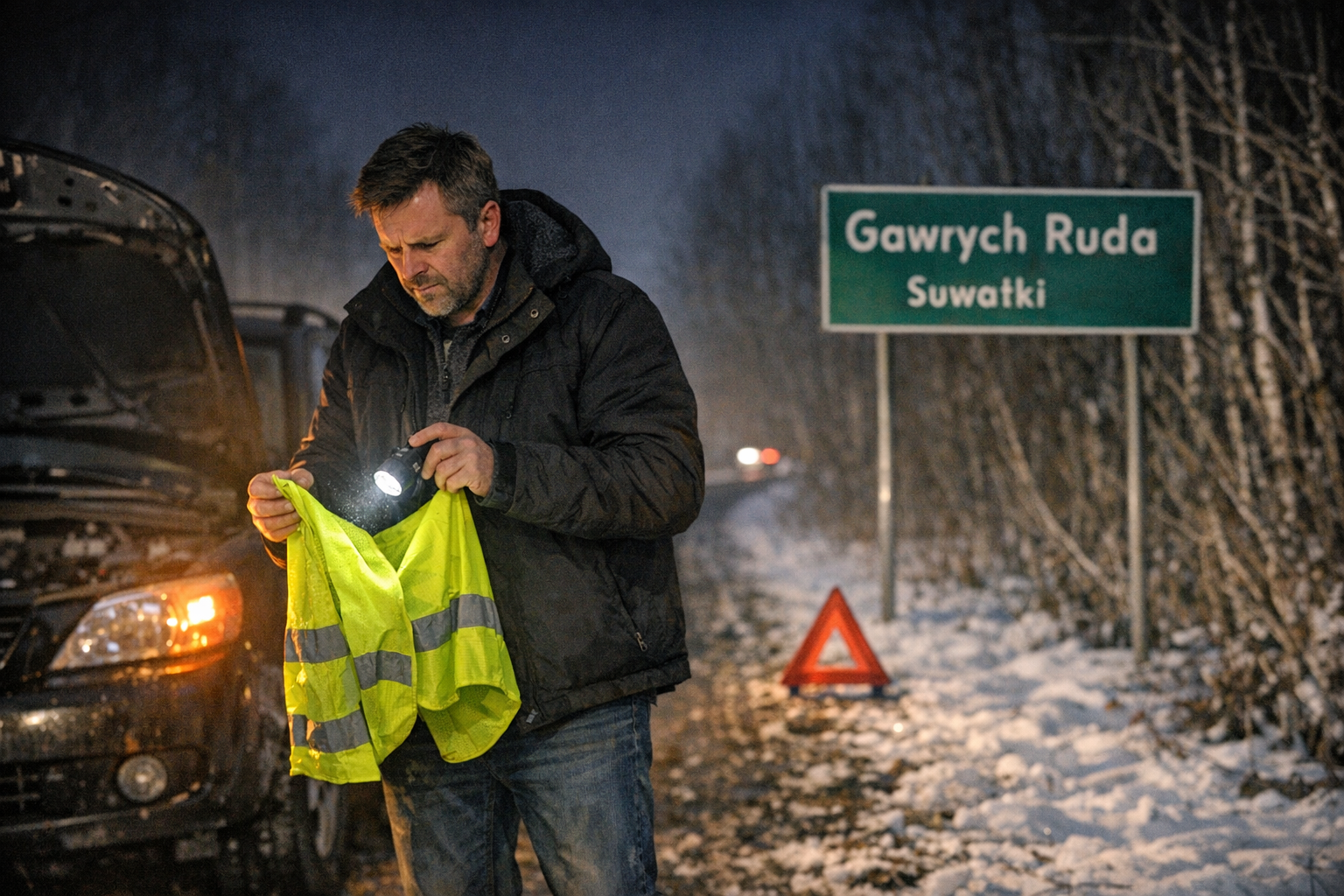
The most common stress? You’re standing in the middle of nowhere, on the road near Gawrych Rudy, minimal traffic, hazard lights not working, streetlights only on the map. These are not urban legends – I know drivers from Suwałki who called SKI TRANS at 2:17 AM because the only thing they had on hand was a dead flashlight and a paper reflective vest from 2007. They naively hoped that „someone” would stop and help.
On this blog, we tackle issues head-on. So if you want to know:
– How does securing the accident scene look in practice on the roads of Podlasie?
– What do you need to have on hand to not miss important formalities?
– And what to prepare for reporting an accident or collision to avoid coming back empty-handed from the insurance company?
Let’s see – step by step.
First: Securing the collision scene – what, where, when?
Properly securing the accident scene is not just a theory from the code, but a practice that can save someone’s life. And your wallet. Here, on the Suwałki-Augustów routes, especially in winter (temperature -20°C, slippery roadside), the responsibility is even greater – cars can crash into poorly marked accident scenes with great force.
Turn off the engine and ensure your own safety
Once you’ve calmed down after the initial shock, the most important thing – turn off the ignition, shift to neutral, turn on the hazard lights. When leaving the vehicle (especially at -15°C on the open stretch between Suwałki and Giżycko), put on a reflective vest. Are you invisible? The risk of secondary collisions increases by 65% according to SKI TRANS statistics from 2023.
Warning triangle – where and how many meters?
Alright, it sounds trivial, but Mr. Andrzej, a client from Suwałki, once got a fine for placing the triangle… 12 meters from the car on a national road. The minimum is 30-50 meters behind the car outside the city (the higher the speed – the further), and on a slippery road, it’s better to place it about 100 m away.
In the city of Suwałki – the triangle should be 1-2 meters behind the vehicle. It seems easy – but in practice? Last December, at the intersection of Reja and Noniewicza, none of the participants in the collision found the triangle. The result – a case for court, as the insurer refused to pay due to improper securing of the collision scene.
Ensure pedestrian and other traffic safety
If the collision occurred near a bus stop (Suwałki – near Kaufland, Żeromskiego), check if pedestrians are at risk. Sometimes the damaged vehicle blocks the crossing – then you have the obligation to move it or set up additional reflectors.
What should you always carry in your car in Podlasie (and what is most missed)?
Every accident story in Suwałki starts with the words: „I didn’t expect this to happen…” The key is preparation. Police statistics: 7 out of 10 drivers do not have a complete safety kit during winter.
Must-have: Your first aid kit and tools
No joke – a first aid kit, a working fire extinguisher (not expired!), a reflective vest for each passenger, a warning triangle. A good quality flashlight – not one from the market for 5 PLN, but a solid headlamp (models for 40-60 PLN in local energy stores in Suwałki work great). If you have children – a thermal blanket, paper towels, and a power bank just in case.
Winter emergency kit
Podlasie does not forgive the lack of a shovel, scraper, and spare windshield washer fluid. Remember, in 65% of reports to SKI TRANS in winter, drivers got stuck because the battery died in the frost – a charger or boost starter for 150-250 PLN is an investment that really makes a difference.
What about documents after a collision?
Okay, stress, snow, chaos – but you need the vehicle registration, liability insurance policy, and ID. If you’re writing a statement – paper, pen, or (better) a ready-made template downloaded from the internet, kept in the glove compartment. Rely on practical solutions, because „I’ll manage on the phone” doesn’t work when the battery dies.
When to call the police, and when is it enough to write a statement?
I often hear: „Do I have to call the police for every collision?” The truth is – not always! If there are no injuries, and both parties agree on fault – a well-written statement is enough. But beware – even the smallest misunderstanding about the version of events calls for police intervention.
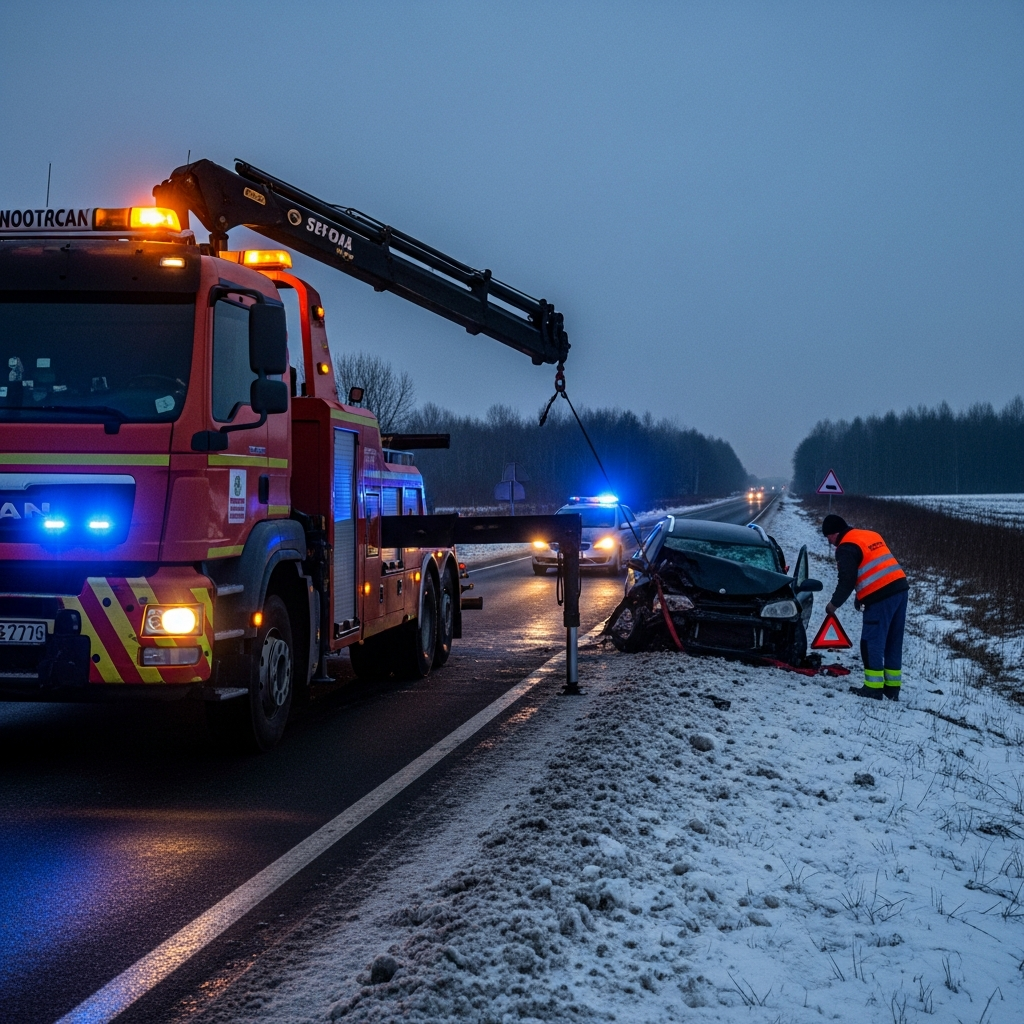
The police on the roads around Suwałki respond on average in 18 minutes (checked in January 2024), but on side roads beyond Gawrych Ruda, you may wait even an hour. During this time, you must take care of securing the accident scene in Suwałki yourself – don’t count on „quick help” from the city.
What data to collect for reporting a collision?
Here, many drivers stumble – especially on transit routes where everyone is in a hurry. Checklist:
– First name, last name, address, PESEL of all participants
– Vehicle data: registration, make, model
– Insurer, policy number
– Location, date, time of the collision (e.g., Suwałki-Giżycko route, January 14, 7:30 PM)
– Description of damages, weather conditions, situational sketch (drawing with the arrangement of vehicles, arrows indicating movement)
– Photos from several perspectives (with a phone)
Don’t know what else? Check the details on the website: securing the accident scene.
Photos from the scene – how to take effective documentation?
If you think that one photo of the license plate is enough, you’re mistaken. The minimum – 5-6 shots: overall situation (roadside, road signs, tire tracks), details of damages, traffic signs in the area. In winter, with falling snow, be sure to use a flash or good light (a flashlight from the car if it’s dark on the road behind Suwałki).
How to avoid hidden costs and chaos after towing?
A collision almost always ends with the need to transport the damaged car. Only 2 out of 10 cases can be resolved „on-site” (according to SKI TRANS data from February 2024). The biggest stress? Costs and uncertainty – what will happen to the car, will the tow truck charge additional fees for „difficult conditions”.
SKI TRANS focuses on clarity – transparent settlements, free arrival in Suwałki, information about the next steps. Want to know what an efficient process looks like after a collision? Check the website for details. take advantage of roadside assistance and not be left alone with the problem.
Is a tow truck the only solution?
Not always do you need towing – sometimes the damage is minor enough that the car can continue. But – never attempt to „tow with a rope” if you lack the knowledge and equipment. You risk a fine, damaging the transmission, and with an automatic, even thousands in damages.
SKI TRANS has its own fleet of tow trucks and equipment suited for the challenging conditions of Podlasie – from snow-covered shoulders to narrow forest roads in the Wigry National Park area.
So – what should you have on hand and how to report an incident?
So? Let’s summarize the checklist:
– Reflective vest, warning triangle, first aid kit, flashlight, blanket, shovel in winter, insurance details in the glove compartment
– Gather all key information: witnesses, photos, a sketch of the situation, policy numbers
– Secure the area so that the next driver can see the obstacle at least 100 meters ahead (outside the city)
– If anything is in doubt – it’s better to call SKI TRANS than risk losing out on insurance or your health.
Don’t leave anything to chance – response time and good organization are your lifeline. This applies to both everyday accidents in Suwałki and more serious incidents on the side roads of Podlasie.
What to avoid? Lack of communication, leaving the car without a rear light, writing statements „on the fly”. And – never trust that „the police will figure out” what the circumstances were.
Need support in a crisis or want to quickly and safely secure the scene of an incident in Suwałki region? Call without delay – 24 hours a day: +48 608 275 667.